Key takeaways
- Find the best motor oil for lawn mowers with our guide to SAE 30 and 10W-30 oils, bottle sizes, and five picks for push and riding mowers.
Choosing the best motor oil for lawn mowers is one of the simplest ways to keep a mower engine running smoothly season after season. The right oil protects moving parts, helps the engine handle heat, and makes starting easier, while the wrong grade can leave an engine under-protected on a hot afternoon or sluggish on a cool morning. Most walk-behind and riding mowers use a 4-cycle engine that takes straight SAE 30 or multi-grade 10W-30 oil, and the owner manual for the engine names the exact grade and fill amount to use.


This guide explains how to match oil to a mower engine, then compares five widely available motor oils made for small 4-cycle engines. Each pick below is a real product sold on Amazon, with its grade, bottle size, and intended use spelled out so the choice is easy to compare. The goal is not to find one universal bottle for every mower, but to help match the oil to the engine brand, the local climate, and the size of the machine doing the work.
How to Choose
1. Match the Viscosity Grade in the Manual
Viscosity grade is the first thing to check. SAE 30 is a single-grade oil that many mower makers recommend for warm weather, generally when temperatures stay above about 40 degrees Fahrenheit. Multi-grade 10W-30 flows more easily at lower temperatures, so it suits mowers used in spring and fall or in regions with wide temperature swings. The engine manual is the authority here: if it lists SAE 30, use SAE 30; if it lists 10W-30, use 10W-30. Using a grade the manual does not list can affect lubrication and, in some cases, warranty coverage.
2. Confirm the Engine Is a 4-Cycle Engine
Most modern push mowers, riding mowers, and lawn tractors use 4-cycle engines, which have a separate oil sump and take straight motor oil. Two-cycle engines, by contrast, burn a gas and oil mixture and need a different product entirely. Every oil in this guide is made for 4-cycle engines. Before buying, confirm the engine type on the mower label or in the manual, and never pour 4-cycle oil into a 2-cycle fuel tank or mix 2-cycle oil into a 4-cycle crankcase.
3. Pick the Right Bottle Size
Oil capacity varies by engine size. A typical push mower engine holds around 15 to 20 ounces of oil, so an 18-ounce bottle covers a single oil change with little left over. Larger riding mower and lawn tractor engines often hold 48 ounces or more, which makes a 48-ounce jug or a quart bottle a better fit. Buying the size that matches the fill amount avoids storing half-empty bottles and makes measuring simpler. Keep a little extra on hand for topping up between changes, since small engines can consume a small amount of oil during normal use.
4. Consider Conventional, Synthetic Blend, and Full Synthetic
Conventional oil is the standard choice for most mower engines and meets the needs of ordinary residential mowing. Synthetic blend oils combine conventional base oil with synthetic components for added protection in heat and under load. Full synthetic oils offer the strongest protection in extreme heat and cold, and some mower owners prefer them for engines that run long hours. All three types work when the grade matches the manual, so the choice comes down to how hard the engine works and how often it runs.
5. Follow the Engine Maker When Possible
Engine makers such as Briggs and Stratton, Honda, Kohler, Toro, and Husqvarna sell oil blended for their own engines. Using the maker-branded oil is a straightforward way to be sure the formulation matches the engine design, and it removes any doubt about compatibility. Generic or multi-brand oils that meet the same grade and service classification also work well, but a maker-branded bottle is the simplest choice for owners who want zero guesswork.
6. Check the API Service Classification
The API service classification on the label, such as SJ or a later letter, shows the oil meets a recognized performance standard. Later classifications generally include the requirements of earlier ones, so an oil rated SJ or higher is suitable for most mower engines. The classification is printed on the bottle and in the product listing, and it is worth a quick check before buying, especially when comparing an unfamiliar brand with a familiar one.
7. Plan for the Climate and the Season
Temperature shapes how oil behaves. SAE 30 thickens in cold weather, which can make cold starts harder, while 10W-30 stays thinner at low temperatures and still protects when the engine is hot. Owners in warm climates who mow through summer can use SAE 30 all season. Owners who mow in cool spring and fall weather, or who use the same engine on a snow blower in winter, get more flexibility from 10W-30. Match the grade to the coldest temperature the engine will face, not just the warmest.
Top Picks
Briggs and Stratton 100005 SAE 30W Engine Oil, 18 Oz
The Briggs and Stratton 100005 is an 18-ounce bottle of SAE 30 detergent oil made for air-cooled 4-cycle engines, and it is the natural first pick for owners of Briggs and Stratton powered push mowers. The 18-ounce size lines up closely with the oil capacity of a typical walk-behind mower engine, so one bottle usually covers a complete oil change without measuring out a larger container. The formulation is designed for the higher operating temperatures of air-cooled engines, where oil runs hotter than in a liquid-cooled car engine.
Who it is for: owners of push mowers with Briggs and Stratton engines who want the maker-branded oil in a single-change size. It suits warm-weather mowing and routine seasonal oil changes.
Caveats: SAE 30 is a warm-weather grade, so it is not the best choice for cold starts or for engines used in cool spring and fall conditions. The 18-ounce bottle is too small for most riding mower engines, which need a larger fill.
Honda Power Equipment 10W-30 Motor Oil, 1-Qt. Bottle
Honda Power Equipment 10W-30 motor oil is a 1-quart bottle of multi-grade oil blended for Honda gasoline engines, including the engines Honda supplies for lawn mowers and other power equipment. The 10W-30 grade flows well at low temperatures and holds its protection when the engine is hot, which makes it a flexible choice for owners who mow across changing seasons. The quart size suits most push mower engines and leaves a small amount for topping up.
Who it is for: owners of Honda-powered mowers and other Honda power equipment who want the maker-branded 10W-30 oil. It is a good fit for regions with cool mornings and warm afternoons.
Caveats: owners of non-Honda engines can use 10W-30 oil, but the Honda branding adds little for engines from other makers. Check the manual first, since some engines specify SAE 30 only. The quart bottle may not hold enough for the largest riding mower engines.
STP Premium Small Engine 4 Cycle Oil, SAE 10W-30, 32 Oz

STP Premium Small Engine 4 Cycle Oil is a synthetic blend 10W-30 oil in a 32-ounce bottle, made for lawn mowers, push mowers, tractors, and other 4-cycle outdoor equipment. The synthetic blend formulation is designed to reduce wear and keep the engine clean under load, and the 10W-30 grade gives it a wide working temperature range. The 32-ounce quart is a practical size for most push mower engines and many smaller riding mowers.
Who it is for: owners who want a synthetic blend oil at a widely available brand, and owners whose mowers run in varied temperatures. It works across engine brands as long as the manual allows 10W-30.
Caveats: it is a multi-brand product rather than a maker-branded oil, so owners who prefer the engine maker’s own bottle may look elsewhere. As with any 10W-30, confirm the manual allows a multi-grade oil before using it in an engine that specifies SAE 30.
Briggs and Stratton 100028 SAE 30 Engine Oil, 48 Oz
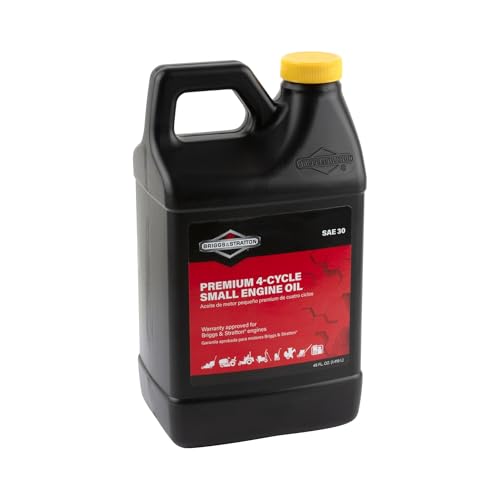
The Briggs and Stratton 100028 is a 48-ounce bottle of SAE 30 detergent oil, the larger sibling of the 18-ounce 100005. It is the same maker-branded SAE 30 formulation for air-cooled 4-cycle engines, sized for riding mowers and lawn tractors that hold more oil. A 48-ounce jug covers the fill on many tractor engines in one pour and leaves enough for a top-up, which makes it practical for owners who maintain more than one machine or a larger property.
Who it is for: owners of riding mowers and lawn tractors with Briggs and Stratton engines, and owners who service several push mowers and want one larger bottle on the shelf. It suits warm-weather mowing and regular seasonal changes.
Caveats: SAE 30 is a warm-weather grade, so it is not suited to cold starts. The 48-ounce size is more oil than a single push mower change needs, so owners of one small mower may prefer the 18-ounce bottle to avoid storing an open jug.
Husqvarna 32-Oz 4-Cycle SAE 30 Mower Engine Oil 593153502

Husqvarna 32-ounce 4-Cycle SAE 30 Mower Engine Oil, part number 593153502, is a quart of SAE 30 oil made for air-cooled 4-stroke engines in the 2 horsepower to 5.5 horsepower range. It is designed to reduce engine wear and scuffing in small mower engines and meets API SJ requirements and higher. The quart size is a natural fit for most push mower engines, covering a full change with a little left over for topping up.
Who it is for: owners of Husqvarna mowers and other small push mowers in the 2 to 5.5 horsepower range who want a quart of maker-branded SAE 30 oil. It suits warm-weather mowing and routine maintenance.
Caveats: it is an SAE 30 oil, so it is best in warm weather and not the pick for cold conditions. The formulation is aimed at smaller engines, so owners of large riding mower engines should check capacity and consider a larger bottle instead.
Comparison Table
| Product | Grade | Oil Type | Bottle Size | Engine Fit |
|---|---|---|---|---|
| Briggs and Stratton 100005 | SAE 30 | Conventional | 18 oz | Push mowers |
| Honda Power Equipment 10W-30 | 10W-30 | Conventional blend | 32 oz | Honda engines |
| STP Premium Small Engine 4 Cycle Oil | 10W-30 | Synthetic blend | 32 oz | Multi-brand 4-cycle |
| Briggs and Stratton 100028 | SAE 30 | Conventional | 48 oz | Riding mowers and tractors |
| Husqvarna 593153502 | SAE 30 | Conventional | 32 oz | Small push mowers, 2 to 5.5 hp |
Which One Is Right for You?
For most push mower owners, the decision starts with the engine brand and the manual. If the mower has a Briggs and Stratton engine and the manual lists SAE 30, the 18-ounce 100005 is the simplest choice: one bottle, one change, and the maker-branded formulation. Honda engine owners get the same simplicity from the Honda 10W-30 quart, with the added flexibility of a multi-grade oil for cooler weather.
Owners of riding mowers and lawn tractors should look at capacity first. A 48-ounce engine needs the larger Briggs and Stratton 100028 jug, while smaller tractor engines may work with a quart. The Husqvarna quart is a good match for smaller push mowers in the 2 to 5.5 horsepower range, especially for Husqvarna machines.
For varied temperatures, a 10W-30 pick makes sense. The STP synthetic blend covers a wide temperature range and works across engine brands, which suits owners who maintain several machines or mow through spring and fall. Owners in consistently warm climates can stay with SAE 30 all season and keep things simple.
Whatever the pick, the habits matter as much as the bottle: change the oil at the interval in the manual, check the level before each mowing session, and top up when the dipstick reads low. A mower that gets fresh oil on schedule will run cleaner, start more easily, and last longer than one that runs on old oil, no matter which of these five bottles is on the shelf.
Frequently Asked Questions
What oil grade do most lawn mowers use?
Most 4-cycle lawn mower engines use SAE 30 or 10W-30 oil. SAE 30 is the common warm-weather choice, while 10W-30 suits wider temperature ranges. The owner manual for the engine names the exact grade, and that listing should guide the choice.
Can I use 10W-30 instead of SAE 30 in a lawn mower?
In many engines, yes, but only when the manual allows it. Some manuals list both SAE 30 and 10W-30, while others specify SAE 30 only. When the manual lists only one grade, use that grade. When it lists both, 10W-30 is the more flexible option for cooler weather.
How much oil does a push mower take?
A typical push mower engine holds about 15 to 20 ounces of oil, though the exact amount varies by engine model. The manual lists the capacity, and the dipstick confirms the level after filling. Add oil slowly and check the dipstick rather than pouring in a full bottle at once.
How often should lawn mower oil be changed?
Most mower manuals recommend changing the oil once per season or after a set number of operating hours, often around 50 hours for residential mowers. Heavy use, dusty conditions, and hot weather can call for more frequent changes. Check the oil level before each use and change it when it looks dark or feels gritty.
Disclosure: As an Amazon Associate, we may earn from qualifying purchases.