Key takeaways
- At 5 feet 3, stand-over height and wheel size decide bike fit more than frame labels. Two verified picks sized for shorter riders, plus a fitting method.
At 5 feet 3 inches, you sit exactly where bicycle sizing gets awkward. Most adult bikes are designed around a middle band of rider heights, and the smallest frame on the chart is often a reluctant afterthought: the wheels stay big, the top tube stays high, and the “small” size is really a medium with a shorter seat tube. The result is a generation of shorter riders who have been told to just manage — toes pointed at stops, bars too far away, a top tube they cannot comfortably stand over.

It does not have to be that way. The right measurements are knowable, and two broad design families genuinely suit a 5’3″ rider: 26-inch-wheel step-through bikes, whose geometry is scaled down everywhere, and 700c hybrids that come in a true extra-small frame. This guide explains the fit, then compares two verified picks, one from each family.
Disclosure: As an Amazon Associate, this site may earn from qualifying purchases made through links in this article, at no additional cost to you.
The three measurements that decide fit
Stand-over height is the first gate. Stand in cycling shoes and measure the height of the bike’s top tube where you would straddle it; you want clear space between you and the tube — roughly an inch or more for a road-style frame, and more for casual riding. Sloped and step-through frames exist largely to solve this number.
Reach is the second. A bike can be low enough to stand over and still stretch you out with a long top tube. For a 5’3″ rider, an effective top tube in the neighbourhood of 500–525 mm, paired with a shorter stem, is the usual comfort zone for hybrid and road positions. If you must slide the saddle fully forward to reach the bars comfortably, the frame is too long.
Crank length and saddle height finish the picture. Shorter riders often do better on 165 mm cranks than the 170–175 mm arms fitted as standard, because a shorter crank keeps the knee angle comfortable at the top of the stroke. Whatever the bike, your saddle height should let your knee keep a soft bend at the bottom of the stroke with your heel able to reach the pedal at its lowest point.
The verified picks
sixthreezero EVRYjourney Women’s — the 26-inch step-through answer
The EVRYjourney women’s model (ASIN B011A4HBTC) is built around the dimensions shorter riders actually need: 26-inch wheels instead of 700c, a low step-through aluminium frame you mount by stepping in rather than swinging a leg over, and an upright riding position with swept-back bars that keeps reach short and your head up. The maker’s own published fit range for the bike runs from about 5 feet to 6 feet 2 inches, which puts a 5’3″ rider comfortably inside the design window rather than at its ragged edge. The same maker publishes a maximum seat height of around 40 inches across the range, and the step-through frame keeps stand-over a non-issue entirely.
It is a comfort hybrid in intent: single-speed and geared versions exist across the range, the position is upright, and it suits neighbourhood riding, paths, errands and relaxed commuting rather than fast group rides. One record-keeping note, stated openly because it matters: listing records for this ASIN are older and not fully consistent between crawls, so treat it as a pick to confirm on the current listing before ordering — check that the live listing is the women’s 26-inch step-through and the size you intend. The model identity and fit range are well documented; the caution is about listing currency, not about what the bike is.
Schwinn GTX — the 700c hybrid in a small frame
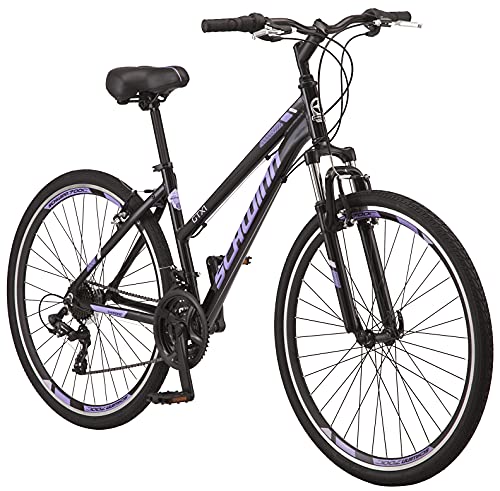
The Schwinn GTX (ASIN B08239VFK6) is the other route: a proper 700c hybrid with an aluminium frame, 21-speed gearing and a suspension fork, in frame sizes that include a small genuinely scaled for shorter riders rather than a cut-down medium. With the saddle set correctly, a 5’3″ rider fits the small GTX without the pointed-toe routine at stops, and the bigger wheels roll faster and smoother on longer rides than the 26-inch alternative.
Choose the GTX if your riding includes longer distances, hills where the wider gearing earns its keep, or a commute where pace matters. Choose the EVRYjourney if your riding is relaxed, upright and local, and if easy mounting and a low step-over matter more than speed. Neither is a wrong answer; they are answers to different questions about how you ride.
Budgeting the whole purchase
A bike that fits still needs the small things that make it yours: a helmet that fits as carefully as the bike does, a lock matched to where the bike will live, lights for any riding near dusk, and a floor pump, since tyres lose air weekly whether ridden or not. None of this changes which bike to buy, but riders who plan for it in the same purchase ride more in the first month — and the first month is when a well-fitting bike turns into a habit. The two picks above leave room in most budgets for exactly that, which is part of their appeal at this height: fit first, then the kit that keeps you riding.
Wheel size, honestly
The 26-inch versus 700c question is practical, not ideological. Smaller wheels lower everything: stand-over, saddle height range, and the whole visual scale of the bike, which is why they suit shorter riders. They accelerate quickly and feel nimble in town. Bigger 700c wheels hold speed better, roll over rough pavement more smoothly, and dominate the market, so tyres and parts are easier to find. A 5’3″ rider can be happy on either; the deciding factor is whether the specific frame’s stand-over and reach fit, not the wheel diameter printed in the headline.
Common mistakes shorter riders are talked into
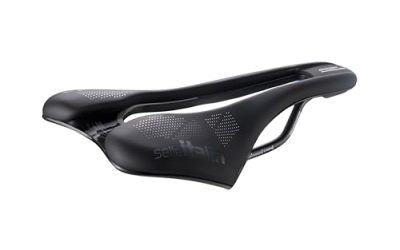
Three recur often enough to name. The first is the comfort saddle swap: a new rider finds the stock saddle firm and fits the widest, softest saddle in the shop, which then chafes on any ride past the neighbourhood — saddle width should follow sit bones, not first impressions. The second is buying a bike with the saddle at its lowest and calling it a fit; if the post is slammed to the frame, the bike is too big, full stop, because a correct saddle height will leave post showing. The third is the step-through dismissal — the idea that a step-through frame is a lesser bicycle. For a shorter rider, a low step-over is a functional advantage every single ride, and modern step-through frames are properly engineered machines. Choose the bike that fits your body and your streets, and let other people’s hierarchies look after themselves.
Setting up whichever bike you choose
Set saddle height first, using the heel method: heel on the pedal at the bottom of the stroke, leg straight without rocking your hips; your knee should then bend softly when the ball of your foot takes over. If the bars feel far, a shorter stem is a cheap correction — but if you need the saddle slammed forward and a much shorter stem, the frame is too big and no setup will fix it. At stops, slide forward off the saddle and stand over the top tube; that is exactly the moment stand-over clearance is for, and a bike that gives you that clearance is a bike that fits.
Geometry terms, translated
Bike listings bury fit in jargon, so here is the short decoder for the terms that matter at your height. Stack is the vertical distance from the bottom bracket to the top of the head tube; lower stack means a lower front end. Reach (in the geometry sense) is the horizontal distance from the bottom bracket to that same point; shorter is better for shorter torsos and arms. Stand-over you already know. Trail and wheelbase describe handling more than fit — shorter riders often prefer the calmer steering of a longer wheelbase, which is another reason comfort hybrids feel reassuring. When comparing two bikes, stack and reach tell you more than the frame’s nominal size, which is why one brand’s small can fit you and another’s cannot: the stickers are not standardised, the millimetres are.
Other formats worth knowing about
If neither pick matches your riding, three other formats genuinely serve shorter riders. 650b (27.5-inch) wheel road and gravel bikes split the difference between the two picks above — lower than 700c, faster-rolling than 26-inch — and several makers size them down honestly. Small-wheel folding bikes put stand-over at zero and suit city riders with storage constraints, at the cost of ride smoothness. Youth and junior performance bikes from serious makers are real bicycles in small sizes, not toys, and a light rider near the boundary sometimes fits them better than an adult extra-small; check the maker’s stated height range rather than assuming. What to avoid: any bike whose smallest size still has you pointing your toes at a stop, whatever the salesperson says about growing into it. Adults do not grow into bikes.
A five-minute test-ride checklist
Wherever you buy, ride before you commit if you possibly can, and run this list. One: straddle the bike in the shoes you will ride in and confirm stand-over clearance. Two: ride in a straight line, hands relaxed — you should not be sliding forward on the saddle to reach the bars. Three: stop and start several times; confidence at stops is the whole ballgame for a new rider. Four: stand and pedal briefly; your knees should clear the bars and your elbows comfortably. Five: check that with the saddle at your correct height, the seatpost still shows a healthy length inside the frame rather than being at its minimum insertion line. A bike that passes all five will still feel right in month six.
Verdict
For a 5 feet 3 inch rider, fit is a measurement, not a label. The sixthreezero EVRYjourney women’s step-through is the comfort answer — 26-inch wheels, a frame you step into, and a published fit range that centres on your height — with a note to confirm the current listing before buying. The Schwinn GTX in its small frame is the distance answer — full-size wheels and gearing in a frame a shorter rider can genuinely stand over. Measure your inseam, check stand-over against the frame you are considering, and let those numbers, not the size sticker, make the decision.