Key takeaways
- Compare five centrifugal juicers with wide feed chutes, strong motors and simple cleanup, plus the key specs to check before you buy one for home use.
A centrifugal juicer shreds produce against a fast-spinning mesh basket, flinging the juice out through the strainer while the pulp collects in a separate bin. Speed is the whole point of the design: a glass of juice takes well under a minute of machine time, and wide feed chutes on current models mean most apples, carrots and cucumbers go in whole or halved rather than chopped. For households that juice in the morning and want the machine washed and put away quickly, this is the category that fits that routine.
The five models below are all dedicated centrifugal extractors, not citrus reamers and not slow presses. They range from an entry-level Breville and a stainless Hamilton Beach to a big-jug batch model, a five-speed die-cast Cuisinart and a high-RPM Mueller. Specs come from the current listings, and anything a listing does not state clearly is marked for you to confirm.
As an Amazon Associate, we earn from qualifying purchases.
Quick Answer
For most home kitchens, a centrifugal juicer with an 850 to 1000 watt motor, a 3 inch feed chute and two speeds covers daily juicing with very little prep. The Breville Juice Fountain Plus JE98XL is the balanced default, the Juice Fountain Cold suits batch juicing, and the Mueller Ultra Power brings the highest stated RPM at a budget-friendly build.
Breville Juice Fountain Plus JE98XL
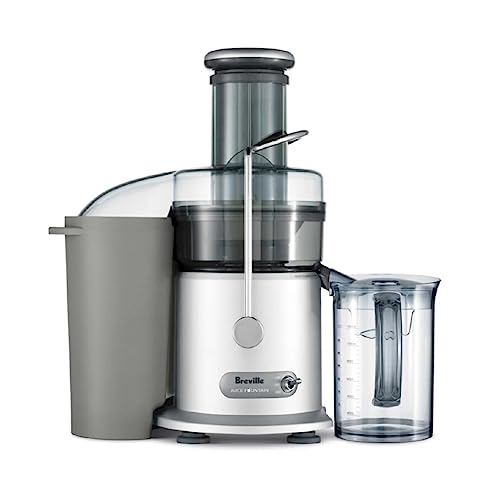
The Juice Fountain Plus is Breville’s long-running entry point into centrifugal juicing, and its spec sheet explains why it keeps selling. An 850 watt motor drives a stainless steel cutting disc and micro mesh filter basket at two speeds: low for softer fruit and high for dense produce like carrots and beets. The 3 inch extra-wide chute takes whole apples and similar produce, which keeps prep to a rinse and the occasional halving.
Juice collects in a 35.2 fl oz jug with a built-in froth separator, and pulp goes to a 2.6 quart container, so a two-person session finishes without stopping to empty anything. The footprint is moderate for the category, though the mesh basket still needs a brush scrub after fibrous produce. If you want one proven machine and do not need a storage jug, this is the straightforward pick.
Specs
- Juicer type: centrifugal extractor
- Motor: 850 watts
- Speeds: 2 (low and high)
- Feed chute: 3 inches, extra wide
- Juice jug: 35.2 fl oz with froth separator
- Pulp container: 2.6 qt
- Filter: stainless steel micro mesh basket, titanium-reinforced cutting disc
- Warranty: 1 year limited
- Finish: silver
Breville Juice Fountain Cold BJE430SIL
The Juice Fountain Cold keeps the same 850 watt motor and 3 inch chute as the Plus, but it is built around batch juicing. Its 70 fl oz jug seals with a lid so a full jug can go straight into the refrigerator, and the pulp container grows to 3.6 quarts to match longer runs. Breville’s Cold Spin Technology routes juice through the stainless steel mesh in a way the listing describes as limiting heat transfer during extraction.
Two speeds cover the usual split between soft fruit and hard vegetables. At roughly 11 pounds it is a mid-weight machine, and the taller jug needs a bit more under-cabinet clearance than the Plus. Care instructions vary by part, so confirm the washing guidance on the listing. Pick this one if your habit is juicing every few days in larger batches rather than a single glass each morning.
Specs
- Juicer type: centrifugal extractor
- Motor: 850 watts
- Speeds: 2
- Feed chute: 3 inches, extra wide
- Juice jug: 70 fl oz seal and store jug with lid
- Pulp container: 3.6 qt
- Technology: Cold Spin Technology per the listing
- Weight: about 11 lb
- Warranty: 1 year limited
- Finish: silver
Cuisinart CJE-1000P1 Die-Cast Juice Extractor
The CJE-1000P1 is the control-focused option in this group. Where most centrifugal juicers offer one or two speeds, the Cuisinart has a five-speed dial with an LED ring, so softer produce can run slower and dense roots can run at full speed. The Amazon listing rates the motor at 1000 watts, and the die-cast metal housing gives it a heavier, more planted feel on the counter than the plastic-bodied models here.
The feed tube is 3 inches across, the juice pitcher holds 1 liter, and the pulp container holds 2 liters, which suits family-size sessions. It is also the tallest machine here at just over 19 inches, so measure your cabinet clearance first. Cuisinart backs it with a limited 3 year warranty, the longest term stated in this group. Choose it if you juice a wide mix of produce and want speed control rather than a simple on-off switch.
Specs
- Juicer type: centrifugal extractor
- Motor: 1000 watts per the listing
- Speeds: 5, dial control with LED ring
- Feed chute: 3 inches
- Housing: die-cast metal
- Juice pitcher: 1 liter
- Pulp container: 2 liters
- Dimensions: 15.35 x 11.8 x 19.01 inches
- Warranty: limited 3 years
- Finish: silver and black
Mueller Juicer Ultra Power
The Mueller Ultra Power leans on motor speed. Its listing states a maximum power of 1100 watts and two speed ranges, roughly 12,000 to 15,000 RPM on low for soft fruit and 15,000 to 18,000 RPM on high for hard produce. The 3 inch chute takes whole fruit, the spout has an anti-drip design, and a safety locking arm keeps the cover seated while the basket spins.
The juice jug holds 34 oz and the pulp container 68 oz, enough for a couple of large glasses before emptying. A cleaning brush is included for the stainless steel micro mesh filter. The build uses more plastic than the Breville or Cuisinart models, which keeps it light but is worth knowing if you prefer metal housings. Mueller states a 2 year warranty. This is the pick for shoppers who want the fastest stated spin speeds without moving up to the premium brands.
Specs
- Juicer type: centrifugal extractor
- Maximum power: 1100 watts per the listing
- Speeds: 2 (about 12,000 to 15,000 RPM low, 15,000 to 18,000 RPM high)
- Feed chute: 3 inches
- Juice jug: 34 oz
- Pulp container: 68 oz
- Spout: anti-drip
- Safety: locking arm, overload protection
- Warranty: 2 years per the listing
- Finish: silver
Hamilton Beach Big Mouth Juicer Machine, Stainless Steel
Hamilton Beach built the Big Mouth line around one idea: a 3 inch chute that fits a whole apple so prep nearly disappears. This stainless steel version runs an 800 watt motor, which is enough for the dense produce most households juice, including carrots, beets and celery. The design has few controls to learn, which makes it a sensible first juicer for a busy kitchen.
The Big Mouth format uses an external pulp bin rather than an internal one, which keeps the machine compact and makes the bin easy to grab and empty. A cleaning brush is included for the strainer. Exact pulp capacity, speed settings and warranty terms for this listing are best confirmed on the product page, since Hamilton Beach sells several similar Big Mouth variants. Choose it if you want wide-chute convenience in a stainless finish from a mainstream brand.
Specs
- Juicer type: centrifugal extractor
- Motor: 800 watts
- Feed chute: 3 inches (Big Mouth)
- Finish: stainless steel and black
- Strainer: stainless steel cutter and strainer
- Pulp bin: external bin, capacity confirm on the listing
- Speeds: confirm on the listing
- Warranty: confirm on the listing
How to Choose
Start with the feed chute. A 3 inch chute is the practical standard here because it swallows whole apples and halves most other produce, cutting prep sharply versus a narrow chute. If a listing does not state chute width, look closer, since it shapes every session.
Motor wattage matters less than it first appears. Most of these machines sit between 800 and 1100 watts, and all can power through hard vegetables. Speed settings are the more useful difference: low helps with soft fruit, high suits roots and dense produce, and the Cuisinart’s five-speed dial adds finer steps between those poles.
Capacity decides how often you stop mid-session. Juice jugs here range from about 34 oz to 70 fl oz, and pulp containers from roughly 2 to 3.6 quarts. Solo juicers can ignore the big numbers; households juicing for several people should match capacity to a full session so nothing overflows.
Finally, plan for cleaning. Every centrifugal juicer has a mesh basket that needs brushing after use, and pulp bins and lids add to the wash load. Models with dishwasher-safe parts and an included brush shorten that job. Also check the machine’s height against your upper cabinets, because taller extractors will not slide under standard cabinet runs while assembled.
Who Should Skip
Skip centrifugal juicers entirely if leafy greens and wheatgrass are the main event. Spinning baskets are at their best with firm produce, and a slow masticating press handles greens more completely. The sumenu.co catalog already covers those machines separately if that is your direction.
Skip this category too if you juice only citrus. A dedicated citrus reamer is smaller, cheaper and easier to wash for oranges and lemons. And if counter space is tight and juicing is occasional, a large extractor with a separate pulp bin will mostly live in a cupboard; a compact model may suit you better. Finally, anyone sensitive to noise should know that high-speed baskets are loud while running, even though each session is short.
FAQ
Are centrifugal juicers hard to clean?
They have more parts than a blender, but the routine is simple: empty the pulp bin, rinse the jug and lid, and brush the mesh basket so fibers do not dry into the screen. Most listings state that removable parts are dishwasher safe, but the basket lasts longer with a quick brush and rinse after each session.
What produce works best in a centrifugal juicer?
Firm fruits and vegetables such as apples, carrots, beets, celery, cucumbers and pears are the strong suit of a spinning basket design. Soft fruit works on the low speed setting. Leafy greens give a lower yield in this style of machine, and bananas and avocados are better suited to a blender because they do not release free-running juice.
Does a bigger motor mean more juice?
Not on its own. Wattage figures are stated differently across brands, and yield depends more on basket design, the speed you choose and how steadily you feed produce through the chute. A mid-range motor at the right speed usually matches a higher-wattage machine run at the wrong setting.
How long does fresh juice keep?
Listings for seal-and-store jugs describe refrigerated storage of up to about two days, and juice generally tastes best the day it is made. Fill the container close to the top to limit the air inside, keep it sealed and refrigerated, and give it a stir or shake before pouring.
Final Verdict
For a single all-round recommendation, the Breville Juice Fountain Plus JE98XL balances power, chute size and jug capacity in a proven design. Batch juicers should step up to the Juice Fountain Cold and its sealing 70 fl oz jug. The Cuisinart CJE-1000P1 suits buyers who want five speeds and a die-cast body, the Mueller Ultra Power is the high-RPM value pick, and the Hamilton Beach Big Mouth keeps things simple with its whole-fruit chute.