Key takeaways
- Compare the best chest freezers for garages and basements, with capacity, temperature range, basket storage, and energy use notes for every pick.
A chest freezer is the simplest way to add serious frozen storage to a home. The top-opening design keeps cold air inside every time the lid lifts, and the interior is one open cavity that swallows bulky items like whole turkeys and pizza boxes. For households that buy meat in bulk or garden through the summer, a dedicated chest freezer pays for itself in avoided food waste and fewer grocery trips.
The five models below cover the sizes most buyers actually need, from compact 3.5 cubic foot units for apartment corners to 7 cubic foot freezers that hold a season of bulk buying. Each entry lists the specs that matter, so you can match a freezer to your space and your shopping habits.
As an Amazon Associate, we earn from qualifying purchases.
Quick Answer
For most households, a 5 cubic foot chest freezer with an adjustable thermostat, a removable storage basket, and manual defrost hits the sweet spot of capacity, footprint, and running cost. Smaller 3.5 cubic foot models suit apartments and couples, while 7 cubic foot units fit bulk buyers who want the most room and the best basket organization.
The 5 Chest Freezers Compared
Frigidaire EFRF5003-BLACK Chest Freezer, 5.0 Cu. Ft.
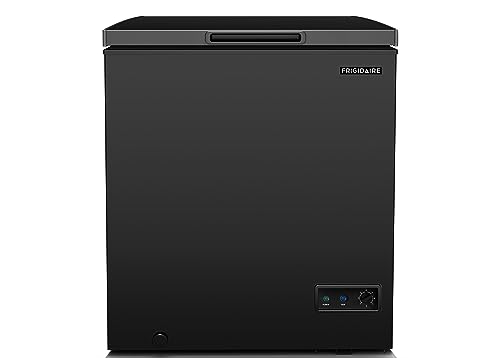
The Frigidaire EFRF5003-BLACK is the straightforward middle-of-the-road pick: 5 cubic feet of storage, a garage-ready build, and a black finish that hides scuffs better than white paint. The adjustable thermostat sits on the exterior, so you can change the setting without lifting the lid. A single removable vinyl-coated wire basket keeps small items up top where they are easy to reach, while the cavity below takes roasts and stacked freezer bags.
Defrosting is manual, but the exterior drain lets meltwater run out through a hose instead of being scooped out by hand. At 23 by 28 inches, the footprint is modest for the capacity, so it fits along a garage wall or in a laundry room corner. Buyers who want a recognized brand and simple controls will find this the least fussy option here.
Specs
- Capacity: 5.0 cubic feet
- Dimensions: 23 x 28 x 35 inches
- Temperature control: adjustable thermostat
- Basket: 1 removable vinyl-coated wire basket
- Defrost: manual, with exterior defrost drain
- Voltage: 120 volts
- Weight: confirm on the listing
- Warranty: 1 year
Northair Chest Freezer, 3.5 Cu. Ft.

The Northair 3.5 cubic foot model is the compact pick for apartments, dorms, and small households, and it stands out for two reasons: it ships with two removable baskets instead of the usual one, and the listing states an unusually wide temperature range reaching minus 40 degrees Fahrenheit for buyers who want deep-cold storage. Seven temperature settings give fine control, and the brand rates energy use at 0.45 kilowatt-hours per 24 hours, the lowest figure here.
The lid is balanced to stay open between 45 and 90 degrees, which helps when both hands are busy loading groceries, and a bottom drain simplifies the occasional manual defrost. The black finish and compact profile let it blend into a kitchen corner or office break area. Shoppers with limited floor space should start here, though 3.5 cubic feet fills up fast for families who buy meat by the case.
Specs
- Capacity: 3.5 cubic feet
- Temperature settings: 7
- Temperature range: 14 to minus 40 degrees Fahrenheit per the listing
- Baskets: 2 removable
- Energy use: 0.45 kWh per 24 hours
- Lid: stays open between 45 and 90 degrees
- Defrost: manual, with bottom drain
- Voltage: 110 volts
- Weight: 50.7 pounds
- Dimensions: confirm on the listing
Midea MRC04M3AWW Chest Freezer, 3.5 Cu. Ft.
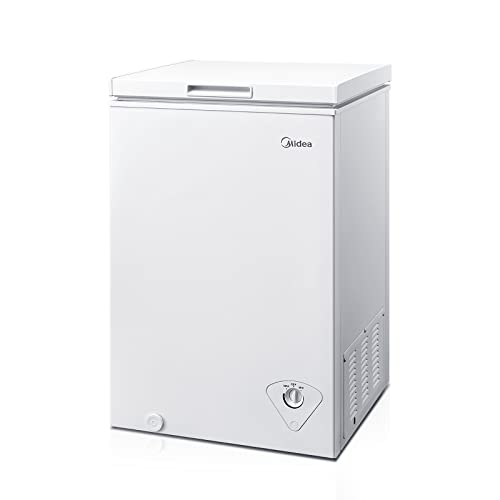
The Midea MRC04M3AWW covers the same compact 3.5 cubic foot class as the Northair but comes from one of the largest appliance makers in the world, a plus for buyers who care about parts and warranty support. Its thermostat adjusts across a listed range of minus 11.2 to 10.4 degrees Fahrenheit, cold enough for long-term meat storage. One removable wire basket rides along the top rim for small items.
The built-in hinge holds the door open between 45 and 75 degrees, so loading does not require a spare hand. A recessed handle keeps the front profile clean, adjustable legs help level the unit on uneven floors, and the defrost drain hole makes the twice-a-year defrost less of a chore. At close to 22 by 21 by 33 inches, it slides into apartment kitchens and offices where a full-size freezer would never fit. This is the compact choice for brand-conscious buyers.
Specs
- Capacity: 3.5 cubic feet
- Temperature range: minus 11.2 to 10.4 degrees Fahrenheit
- Basket: 1 removable wire basket
- Defrost: manual, with drain hole
- Dimensions: 22.24 x 21.26 x 33.46 inches
- Wattage: 120 watts
- Voltage: 120 volts
- Weight: about 51 pounds
- Warranty: 1-year limited
WANAI Chest Freezer, 5.0 Cu. Ft.

The WANAI 5.0 cubic foot freezer takes a different approach to the mid-size class: its seven-level control reaches beyond freezing into refrigerator territory. Levels 1 and 2 hold 32 to 50 degrees Fahrenheit for drinks and produce, while levels 3 through 7 cover the freezing range down to minus 11.2 degrees Fahrenheit. That flexibility suits households that want one box to double as a drinks cooler in summer and a true freezer the rest of the year.
The listing rates energy use at 0.67 kilowatt-hours per 24 hours and noise at about 40 decibels from the R600a compressor. The footprint is unusually slim at roughly 26 by 18 inches, so it threads into narrow utility rooms where wider 5 cubic foot models will not go. One removable plastic basket handles small items, the embedded handle keeps the front flush, and defrosting is manual. Buyers who value the fridge-to-freezer range and the narrow profile over brand recognition will find the WANAI the most versatile pick here.
Specs
- Capacity: 5.0 cubic feet
- Dimensions: 26.18 x 17.51 x 30.31 inches
- Temperature control: 7 levels; freezer range minus 11.2 to 32 degrees Fahrenheit on levels 3 to 7
- Energy use: 0.67 kWh per 24 hours
- Basket: 1 removable plastic basket
- Defrost: manual
- Wattage: 70 watts
- Voltage: 120 volts
- Weight: confirm on the listing
Kismile Chest Freezer, 7.0 Cu. Ft.

The Kismile 7.0 cubic foot freezer is the organization pick and the largest model in this roundup. Its standout feature is three removable hanging wire baskets — triple the usual count — which turn the top layer into sorted storage while bulk items sit below. For families who freeze garden produce or buy warehouse-club meat packs, that basket count keeps the freezer usable instead of becoming an archaeological dig.
The listed temperature range runs from 6.8 down to minus 7.6 degrees Fahrenheit, energy use is stated at 0.66 kilowatt-hours per day, and the listing puts noise below 38 decibels, the quietest figure here. A balanced hinge holds the lid open hands-free for loading big hauls, and a defrost drain supports the manual defrost routine. Shoppers whose main complaint about chest freezers is digging and disorganization should look at the Kismile first.
Specs
- Capacity: 7.0 cubic feet
- Baskets: 3 removable hanging wire baskets
- Temperature range: 6.8 to minus 7.6 degrees Fahrenheit
- Energy use: 0.66 kWh per day
- Noise: below 38 decibels per the listing
- Lid: balanced hinge, stays open for loading
- Defrost: manual, with defrost drain
- Weight: 60.5 pounds
- Dimensions: confirm on the listing
How to Choose a Chest Freezer
Start with capacity, because it drives everything else. A common planning figure is that one cubic foot holds roughly 35 pounds of frozen food, so a 3.5 cubic foot model suits one or two people storing overflow, a 5 cubic foot model fits most families who shop weekly, and 7 cubic feet or more makes sense for bulk buyers, gardeners, and hunters. Measure your space before ordering, including open-lid ceiling clearance and the doorways the box must pass through.
Next, check the temperature range and control style. Most home freezing happens at 0 degrees Fahrenheit or below, and every model here reaches that; wider ranges matter if you want deep-cold storage or, like the WANAI, a refrigerator mode. If the freezer will live in an unheated garage, look for a garage-ready rating like the Frigidaire carries, since garage temperatures swing widely across the year.
Finally, weigh the ownership details. Manual defrost is standard in this class and keeps purchase and running costs low, but plan on defrosting once or twice a year; a drain makes that far easier. Baskets are the main organization tool, so count them. Then compare listed daily energy use, since a freezer runs around the clock and small differences add up over years of service.
Who Should Skip a Chest Freezer
Skip the chest format if bending and reaching into a deep cavity is difficult; an upright freezer with shelves keeps everything at waist height and is easier to organize without baskets. Skip it if your only spot regularly exceeds the ambient range in the listing, or if you cannot leave a few inches of air clearance around the cabinet. Households that freeze only a few bags of vegetables do not need one at all. And if frost buildup is a deal-breaker, know that frost-free chest models are rare; plan for manual defrosting or choose an upright frost-free design instead.
FAQ
How long does food stay frozen in a chest freezer during a power outage?
A full, unopened chest freezer keeps food frozen far longer than a refrigerator freezer, because the insulated cavity loses cold slowly when the lid stays shut. Exact hold times vary by model, fill level, and room temperature, so check the listing for any stated figure and keep the lid closed during an outage.
Does a chest freezer need a dedicated circuit?
Most chest freezers this size run on a standard household outlet and draw modest power, but manufacturers advise plugging the unit directly into a grounded wall outlet rather than an extension cord. If the circuit already carries other heavy loads, an electrician can confirm whether a dedicated circuit is worthwhile.
How often does a manual defrost chest freezer need defrosting?
Most owners defrost once or twice a year, or whenever frost approaches roughly half an inch thick on the interior walls. Thick frost reduces usable space and makes the compressor work harder. Models with a defrost drain let meltwater run out instead of being towelled up from the cavity floor.
Can a chest freezer sit directly on a garage floor?
Yes, most models are designed for floor placement in garages and basements, and adjustable legs on some units help with leveling. Leave the clearance the manual specifies, keep the area dry, and confirm the model is garage-ready rated if your garage sees extreme heat or cold.
Final Verdict
For most buyers, the Frigidaire EFRF5003-BLACK is the balanced choice: a garage-ready 5 cubic foot cavity, an exterior thermostat, and a defrost drain from a major appliance brand. Small households should look at the Northair for its two baskets and deep-cold range, or the Midea for brand support. The WANAI earns its place with a slim footprint and a control range that doubles as refrigeration, while the Kismile is the clear pick for bulk buyers who want 7 cubic feet and three baskets for organization.