Key takeaways
- Compare the best nut milk makers for almond, oat, soy and cashew milk at home, with batch sizes, heating cycles, self-cleaning and pulp handling covered.
A dedicated nut milk maker takes the two fiddliest parts of homemade plant milk, blending and straining, and folds them into one countertop appliance. Instead of squeezing a nut milk bag over the sink, you load nuts, seeds, or grains with water, press a button, and pour. You also decide exactly what goes into every batch: the base ingredient, the water ratio, and any flavoring.
The five machines below split into two families. Basket-style makers such as the Almond Cow and Nama M1 blend cold or room-temperature milk and separate the pulp during the cycle. Heated makers in the soy milk maker tradition, including the ChefWave Milkmade, SoyaJoy G5, and Tribest Soyabella, cook soy and grain milks with built-in heating elements and preset programs. This guide compares batch sizes, cycle types, and cleaning systems so you can match a machine to the milk you actually drink.
As an Amazon Associate, we earn from qualifying purchases.
Quick Answer
For big, fast batches of cold nut milk with no separate straining step, the Almond Cow is the straightforward pick. For the smoothest texture, the Nama M1 blends and strains in a single container. The ChefWave Milkmade suits one or two people with small preset batches, while the SoyaJoy G5 and Tribest Soyabella add heating for cooked soy and grain milks.
Almond Cow Nut Milk Maker Machine

The Almond Cow is built around a simple idea: a stainless steel filter basket holds your nuts, seeds, or grains, the blade in the lid blends them into the water in the base, and the basket keeps the pulp separated so there is no bag to squeeze afterward. One button starts the cycle.
Batch size is the headline here. Each run makes 5 to 6 cups, which suits households that go through a pitcher of plant milk every couple of days. All food-contact surfaces are stainless steel, and the collector cup doubles as your pouring and storage vessel.
The trade-offs are equally clear. This is a cold-process machine with no heating element, so soy milk that needs cooking is better handled by a heated maker below. The parts are hand wash only, and the basket needs emptying and rinsing between batches. If your routine is raw almond or oat milk in quantity, though, the Almond Cow keeps the process to load, press, pour.
Specs
- Batch size: 5 to 6 cups per batch
- Collector capacity: 60 fl oz
- Food-contact material: stainless steel
- Power: 120 volts
- Operation: one-button start
- Straining: built-in filter basket, no separate straining step
- Care: hand wash only
Nama M1 Plant Milk Maker

The Nama M1 takes a different route to pulp separation. Its patent-pending process blends the ingredients at high speed and then gently separates the solids inside the same container, so the milk finishes smooth and the pulp comes out fine and dry enough to fold into baking or oatmeal. There is no pre-soaking step and no nut milk bag to wring out.
This is the pick aimed at coffee drinkers. The M1 is positioned for barista-style texture, the kind of milk that pours into lattes without separating into a thin, watery layer. It handles nuts, seeds, and grains, and the included pitcher set, pulp pouch, and recipe book cover storage and first batches.
Because it is a blend-and-strain machine rather than a heated soy milk maker, it does not cook soybeans; households that drink mostly soy milk should look at the heated models below. For raw nut and oat milk with the least cleanup, the M1 is the premium option in this group.
Specs
- Process: blends and strains in one container
- Prep: no pre-soaking required
- Milk types: nut, seed, and grain milks
- Included: pitcher set, pulp pouch, cleaning brush, recipe book
- Voltage: 120 volts
- Warranty: 15 years per the maker
- Capacity and wattage: confirm on the listing
ChefWave Milkmade Soy Milk Maker
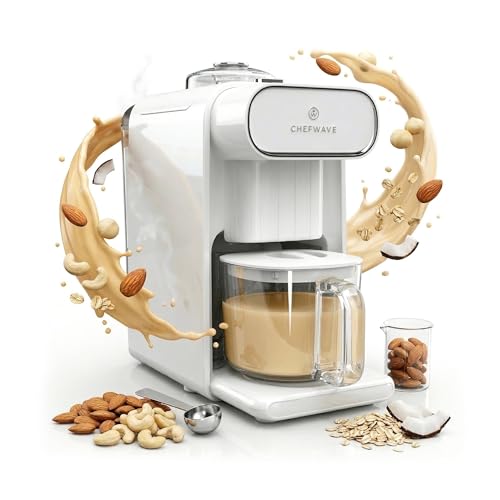
The ChefWave Milkmade is the compact, preset-driven option. Six programs cover almond, oat, soy, cashew, coconut, and macadamia milk, and each run finishes in under 16 minutes according to the maker. You choose between a 10 fl oz batch or a 20 fl oz batch, which keeps small households from storing more milk than they will use.
Milkmade needs no soaking and no straining bag: the machine blends, heats, and filters the pulp internally, then runs an auto-clean cycle afterward. A delay-start option lets you load ingredients ahead, and the finished milk pours into an included glass pitcher for storage.
The small batch ceiling is the main limitation. Twenty ounces is fine for a couple of coffee drinkers but means multiple cycles for a family, and the maker notes the machine is not for use at high altitudes. If your household drinks plant milk by the glass rather than by the pitcher, the Milkmade’s presets keep the daily routine short.
Specs
- Programs: 6 presets (almond, oat, soy, cashew, coconut, macadamia)
- Batch sizes: 10 fl oz or 20 fl oz
- Cycle time: under 16 minutes per the maker
- Wattage: 1000 watts
- Cleaning: auto-clean function
- Extras: delay start, glass pitcher included
- Note: not for use at high altitudes, per the maker
SoyaJoy G5 8-in-1 Milk Maker

The SoyaJoy G5 comes from the heated soy milk maker tradition and is the largest machine in this roundup. Its one-piece stainless steel chamber holds 1.6 liters, and bottom heating cooks soy milk from soaked or dry beans while temperature, water-level, and boil-over sensors manage the cycle.
Eight functions cover soy, almond, quinoa, oat, cashew, and other nut milks, plus soups, porridges, and hot cocoa. A dedicated raw program makes no-cook milks such as almond without heating them, which gives the G5 a foot in both camps: cooked soy milk on weekdays, raw nut milk when you want it. A self-cleaning function and an included fine metal mesh sieve and measuring cup round out the package.
The G5 is a bigger appliance than the basket-style makers, and filtering through the included sieve is a manual step the Almond Cow and Nama skip. For households that drink soy milk daily and want one machine for porridge and soup as well, it is the most versatile heated pick here.
Specs
- Capacity: 1.6 liters
- Wattage: 900 watts
- Voltage: 110 volts
- Functions: 8, including a raw milk program
- Chamber: one-piece stainless steel interior
- Cleaning: self-cleaning function
- Included: stainless steel sieve, measuring cup, power cord
Tribest SB-130 Soyabella Automatic Soy and Nut Milk Maker
The Tribest Soyabella is the long-running compact entry in the heated category. Its stainless steel carafe works with interchangeable screens: a milk screen for soy, almond, rice, and cashew milk, and a rice paste screen for porridges and pureed soups. Raw nut milk is ready in as little as 30 seconds per the maker, while hot bean and grain milks take about 15 minutes.
A hidden heating element inside the boiling chamber, rather than an exposed coil, keeps the cooking surface smoother and easier to wipe down. The Soyabella also doubles as a dry grinder: the included grinding cup handles coffee beans, flax seeds, and spices, which gives it a second job most milk makers cannot do.
Capacity tops out at 1.3 liters, smaller than the SoyaJoy, and the screens need rinsing after each use. If counter space is tight and you want one small appliance that makes cooked soy milk, quick raw nut milk, and the occasional batch of ground coffee or spices, the Soyabella covers all three.
Specs
- Model: SB-130
- Capacity: 1.3 liters
- Carafe: stainless steel
- Raw nut milk cycle: about 30 seconds per the maker
- Hot soy milk cycle: about 15 minutes per the maker
- Heating element: concealed inside the boiling chamber
- Included: milk screen, rice paste screen, grinding cup, measuring cup, cleaning tools
How to Choose a Nut Milk Maker
Start with the milk you drink most. Soy and other bean or grain milks need cooking, so choose a heated machine with a soy program: the SoyaJoy G5, Tribest Soyabella, or ChefWave Milkmade. If you mostly make raw almond, cashew, or oat milk, a cold-process basket or blend-and-strain machine such as the Almond Cow or Nama M1 is simpler and faster.
Match batch size to your household. The Almond Cow makes 5 to 6 cups at once and the SoyaJoy holds 1.6 liters, while the Milkmade works in 10 or 20 fl oz servings. Fresh plant milk has a short fridge life, so a smaller batch you finish beats a large batch that sits.
Then weigh the cleanup. Internal filtering and auto-clean cycles reduce daily effort; machines with separate screens or sieves ask for a rinse and occasional scrub. Finally, check the extras you will actually use: delay start for morning batches, a raw program for no-cook milks, and dry-grinding attachments if you want the machine to earn its counter space.
Who Should Skip a Nut Milk Maker
Skip the category if you only make plant milk once or twice a month. A blender and an inexpensive nut milk bag handle occasional batches without adding another appliance to store.
Also skip it if your household goes through several pitchers a day. Even the largest machines here top out around 1.6 liters or 6 cups per cycle, so high-volume drinkers would run back-to-back batches. And if you only ever drink one kind of milk and like a specific store brand’s flavor, a machine gives you ingredient control you may not want. These makers reward people who make milk several times a week.
FAQ
Do nut milk makers heat the milk?
Some do and some do not. Heated models such as the SoyaJoy G5, Tribest Soyabella, and ChefWave Milkmade cook soy and grain milks with built-in heating elements. Basket and blend-and-strain machines such as the Almond Cow and Nama M1 work cold or at room temperature, so they suit raw nut and oat milks.
Do I have to soak nuts before using one?
Usually not. Most current machines, including all five picks here, are designed to work with dry nuts, seeds, and grains, and several heated models accept dry soybeans as well. Soaking can still soften very hard ingredients and change the texture, so follow the recipe guidance for your specific machine.
How long does homemade nut milk keep in the fridge?
Homemade plant milk without preservatives generally keeps for about three to five days refrigerated in a sealed container, and it should be shaken before pouring because separation is normal. Smaller batches help match production to that window.
Can a nut milk maker make anything besides milk?
Several can. The SoyaJoy G5 adds soups, porridges, and hot cocoa programs; the Soyabella makes porridge and pureed soups and grinds coffee beans and spices; the ChefWave Milkmade supports flavored milks. The Almond Cow and Nama M1 stay focused on milk.
Final Verdict
For most households switching from cartons, the Almond Cow is the easiest starting point: big batches, one button, and no straining bag. Texture-focused coffee drinkers should step up to the Nama M1, while small households fit the ChefWave Milkmade’s single-serving presets. If cooked soy milk is your staple, the SoyaJoy G5 offers the largest capacity and widest program list, and the Tribest Soyabella remains the compact heated option with a dry-grinding bonus. Pick by the milk you drink most.