Key takeaways
- Five Dolby Atmos soundbars that fill a room with height, depth and clear dialogue, from compact single bars to full surround systems with wireless rears.
Disclosure: As an Amazon Associate, we earn from qualifying purchases.


A Dolby Atmos soundbar can turn an ordinary evening in front of the TV into something closer to a cinema visit. Height channels lift sound above the seating area, dialogue stays anchored to the screen, and a good subwoofer gives action scenes real weight. The hard part is that every maker uses the same Dolby Atmos badge while building very different hardware. Some bars fire sound upward from drivers in the bar itself. Others lean on processing to create a sense of height with no upward drivers at all. Some ship with a wireless subwoofer and rear speakers in the box, while others are a single bar that expects you to add bass later.
This guide covers five Dolby Atmos soundbars still selling on Amazon US, from a compact single-bar option to a full multi-piece surround system. Every pick below decodes Dolby Atmos, and each one is labelled honestly for how it creates its height effects.
Quick Picks
Our Short List of 3
- Best for: A large living room where you want a full cinema setup with real rear speakers and deep bass, and a TV setup that can use the HDMI passthrough for a console.
- Channels: 11.1.4
- Drivers: 22 across the bar, subwoofer, and rear speakers
- Subwoofer: wireless 8-inch, included
- Rear speakers: wireless, included
- Best for: A living room where you want one clean bar under the TV with strong Atmos height and no extra boxes, and a home that already uses Sonos speakers or the Sonos app.
- Channels: 9.1.4
- Drivers: 14, including a Sound Motion woofer
- Subwoofer: none in the box; pairs with a Sonos Sub, sold apart
- Dolby Atmos: Dolby Atmos with up-firing drivers in the bar
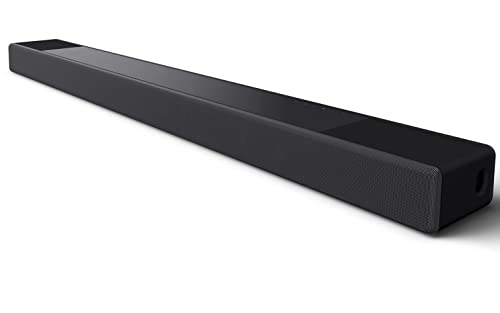
- Best for: A single-bar setup in a medium or large room where you want strong bass without a separate subwoofer box, and a Sony TV owner who wants a bar that pairs cleanly with the set.
- Channels: 7.1.2
- Output: 500W
- Subwoofers: dual, built into the bar
- Dolby Atmos: Dolby Atmos and DTS:X
All 5 Picks at a Glance
| Product | Specs | Action |
|---|---|---|
| Samsung HW-Q990D |
| Check price on Amazon |
| Sonos Arc Ultra |
| Check price on Amazon |
| Sony HT-A7000 |
| Check price on Amazon |
 Bose Smart Soundbar 900 |
| Check price on Amazon |
 LG S95TR |
| Check price on Amazon |
How to Choose
Dolby Atmos decoding versus virtualized Atmos
The first thing to check is whether a soundbar decodes Dolby Atmos or only creates a virtual version of it. A bar that decodes Atmos reads the height data in the soundtrack and sends it to real upward-firing drivers, which bounce sound off the ceiling and down toward the seating area. A virtualized bar uses processing to widen the soundstage and suggest height, but no sound ever travels upward. Virtualized Atmos can still sound spacious, and it suits a small room or a low ceiling, but it cannot match the overhead effect of real up-firing drivers. Every pick in this guide decodes Dolby Atmos, and the table above notes which ones use real up-firing drivers.
Channel count
The channel numbers in a soundbar name describe how many directions sound comes from. The first number counts the main channels across the front and around the room, the second counts the subwoofer, and the third counts the height channels. An 11.1.4 system has eleven main channels, one subwoofer channel, and four height channels. A 5.0.2 bar has five main channels, no subwoofer channel, and two height channels. More channels usually mean a wider, taller soundstage, but the number alone does not tell the whole story. A well-tuned 5.0.2 bar can sound better than a sloppy 11.1.4 system.
Subwoofer: built-in versus a separate box
Bass makes the biggest difference in movie sound, and makers handle it three ways. Some bars hide small subwoofers inside the bar itself, which keeps the setup to one slim unit and works well in smaller rooms. Some ship with a wireless subwoofer in the box, which adds deep bass without a cable run across the floor. Others ship with no subwoofer at all and let you add one later. A separate wireless subwoofer almost always reaches deeper than a built-in unit, because it has a larger driver and its own enclosure. If your room is large or you watch a lot of action films, a bar with a wireless subwoofer in the box is the safer choice. If you live in an apartment with thin walls or you want the cleanest possible look under the TV, a single bar with built-in bass keeps things simple.
Room size
Room size decides how much soundbar you need. In a bedroom or a small living room, a compact bar with two height channels fills the space without overwhelming it, and a large multi-piece system can sound boomy in the same room. In a medium living room, a bar with a wireless subwoofer and a wider front stage gives movies room to breathe. In a large open-plan room, you need either a powerful single bar or a full system with rear speakers, because sound has farther to travel and more air to fill. Ceiling height matters too. Up-firing drivers need a flat ceiling at a normal height to bounce sound back down. A very high or vaulted ceiling weakens the overhead effect, and in that case a system with rear speakers carries more of the surround work.
Connection and fit
Almost every Dolby Atmos soundbar connects to the TV through HDMI eARC, which carries the full Atmos signal from the TV back to the bar over a single cable. Check that your TV has an HDMI eARC or ARC port before you buy, and use the HDMI cable that comes in the box where one is included. Measure the width of your TV stand as well. A flagship bar can be wider than a small TV, and a bar that overhangs the stand looks wrong and can block the TV sensor. Also check the bar height against the bottom edge of the screen, so the bar does not cover any part of the picture.
Best Soundbars With Dolby Atmos
Samsung HW-Q990D
- Best for: A large living room where you want a full cinema setup with real rear speakers and deep bass, and a TV setup that can use the HDMI passthrough for a console.
- Channels: 11.1.4
- Drivers: 22 across the bar, subwoofer, and rear speakers
- Subwoofer: wireless 8-inch, included
- Rear speakers: wireless, included
A large living room where you want a full cinema setup with real rear speakers and deep bass, and a TV setup that can use the HDMI passthrough for a console.
This four-piece system needs floor space for the subwoofer and a place for the rear speakers behind the seating area. It is the most involved setup here, and the rears need power outlets near the back of the room.
The HW-Q990D is the most complete system in this guide. It is an 11.1.4-channel setup with a soundbar, a wireless subwoofer, and two wireless rear speakers, and it decodes Dolby Atmos with up-firing drivers in the bar and in the rear speakers. The package carries 22 drivers in total across its four pieces.
Watch out for: This four-piece system needs floor space for the subwoofer and a place for the rear speakers behind the seating area. It is the most involved setup here, and the rears need power outlets near the back of the room.
Sonos Arc Ultra
- Best for: A living room where you want one clean bar under the TV with strong Atmos height and no extra boxes, and a home that already uses Sonos speakers or the Sonos app.
- Channels: 9.1.4
- Drivers: 14, including a Sound Motion woofer
- Subwoofer: none in the box; pairs with a Sonos Sub, sold apart
- Dolby Atmos: Dolby Atmos with up-firing drivers in the bar
A living room where you want one clean bar under the TV with strong Atmos height and no extra boxes, and a home that already uses Sonos speakers or the Sonos app.
Bass is good for a single bar, but it cannot match a separate wireless subwoofer on deep action scenes. Adding a Sonos Sub later lifts the low end a lot, and that is an extra purchase to plan for.
The Arc Ultra is the premium single-bar pick here: a 9.1.4-channel bar with 14 drivers and a Sound Motion woofer, decoding Dolby Atmos through up-firing drivers in the bar. No subwoofer ships in the box, so the bar carries the bass alone, and it does so better than most single bars. It connects through HDMI eARC and streams over Wi-Fi and Bluetooth, with AirPlay 2 and Spotify Connect built in.
Watch out for: Bass is good for a single bar, but it cannot match a separate wireless subwoofer on deep action scenes. Adding a Sonos Sub later lifts the low end a lot, and that is an extra purchase to plan for.
Sony HT-A7000
- Best for: A single-bar setup in a medium or large room where you want strong bass without a separate subwoofer box, and a Sony TV owner who wants a bar that pairs cleanly with the set.
- Channels: 7.1.2
- Output: 500W
- Subwoofers: dual, built into the bar
- Dolby Atmos: Dolby Atmos and DTS:X
A single-bar setup in a medium or large room where you want strong bass without a separate subwoofer box, and a Sony TV owner who wants a bar that pairs cleanly with the set.
It is a wide, heavy flagship bar, so measure your TV stand and check the clearance under the screen before you order. The built-in bass is strong, but a separate wireless subwoofer still reaches deeper, and Sony sells one apart if you want more low end.
The HT-A7000 is Sony’s flagship all-in-one bar: a 7.1.2-channel unit with 500W of output and dual subwoofers built in, so it produces real low end without a separate box. It decodes Dolby Atmos and DTS:X, and it uses Sony’s 360 Spatial Sound Mapping, Vertical Surround Engine, and S-Force Pro Front Surround to widen the soundstage.
Watch out for: It is a wide, heavy flagship bar, so measure your TV stand and check the clearance under the screen before you order. The built-in bass is strong, but a separate wireless subwoofer still reaches deeper, and Sony sells one apart if you want more low end.
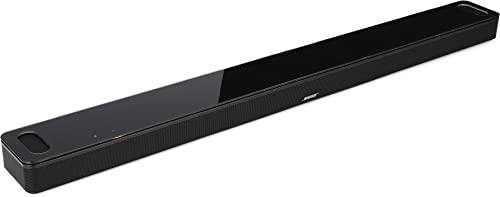
Bose Smart Soundbar 900
- Best for: A bedroom or a smaller living room where you want clear dialogue, a slim bar that fits under the TV, and a bar that also sounds good with music.
- Channels: 5.0.2
- Dolby Atmos: Dolby Atmos with up-firing drivers
- Subwoofer: none in the box; pairs with a Bose Bass Module, sold apart
- Connectivity: HDMI eARC, optical, Wi-Fi, Bluetooth, AirPlay 2, Spotify Connect
A bedroom or a smaller living room where you want clear dialogue, a slim bar that fits under the TV, and a bar that also sounds good with music.
Bass is the weak point, because there is no subwoofer in the box and the bar is slim. Action films lose some weight until you add a Bose Bass Module, an extra purchase. The bar also has fewer channels than the bigger picks here, so the surround effect is narrower.
The Bose Smart Soundbar 900 is the most compact premium pick here, and the one to choose when dialogue clarity and music matter as much as movie effects. This 5.0.2-channel bar decodes Dolby Atmos with up-firing drivers and uses Bose processing to widen the soundstage. It has no subwoofer in the box, and its slim profile fits under most TVs without blocking the screen.
Watch out for: Bass is the weak point, because there is no subwoofer in the box and the bar is slim. Action films lose some weight until you add a Bose Bass Module, an extra purchase. The bar also has fewer channels than the bigger picks here, so the surround effect is narrower.
LG S95TR
- Best for: A large room with an LG OLED TV, where you want a full surround system with wireless rears and a wireless subwoofer, and a setup where the extra center height channel helps dialogue stay clear.
- Channels: 9.1.5
- Output: 810W
- Subwoofer: wireless, included
- Rear speakers: wireless, included
A large room with an LG OLED TV, where you want a full surround system with wireless rears and a wireless subwoofer, and a setup where the extra center height channel helps dialogue stay clear.
This four-piece system needs the same floor space and rear-speaker placement as the Samsung flagship. Some of its best features, like WOW Orchestra, only work with matching LG TVs, so buyers with another TV brand get less from it.
The S95TR is LG’s flagship soundbar system, built to pair with a large LG OLED TV. This 9.1.5-channel system has 810W of output, a wireless subwoofer, and two wireless rear speakers in the box. It decodes Dolby Atmos and DTS:X with triple up-firing drivers, including a dedicated center up-firing speaker in the bar and up-firing drivers in the rears. WOWCAST is built in, so the bar can connect wirelessly to a matching LG TV.
Watch out for: This four-piece system needs the same floor space and rear-speaker placement as the Samsung flagship. Some of its best features, like WOW Orchestra, only work with matching LG TVs, so buyers with another TV brand get less from it.
Which One Fits
Match the bar to the room and to how much gear you want in it. For the fullest cinema sound in a large room with space behind the sofa, the Samsung HW-Q990D and the LG S95TR are the two full systems here, and both ship with a wireless subwoofer and wireless rear speakers. Pick the Samsung if you game on a console and want HDMI passthrough, and pick the LG if you own a matching LG OLED TV.
If you want one bar and nothing else, the choice is between the Sonos Arc Ultra and the Sony HT-A7000. The Sonos is the cleaner single-bar design with strong height effects and a deep streaming feature set, while the Sony carries more bass on its own through its built-in dual subwoofers. Sonos households should take the Arc Ultra; buyers who want the most bass from a single box should take the Sony.
If your room is smaller and dialogue matters most, the Bose Smart Soundbar 900 is the right size. It is slim, it keeps voices clear, and it sounds good with music. Plan to add a Bass Module later if action films feel light, and know the surround effect is narrower than the bigger bars here.
Common Mistakes
The most common mistake is buying a bar for its Atmos badge without checking how it creates height. A bar with no up-firing drivers can still carry the Dolby Atmos name, and it will sound wider than a plain bar, but it will not put sound above you. Read the channel layout and look for up-firing drivers before you buy.
The second mistake is skipping the HDMI eARC check. Dolby Atmos needs an HDMI eARC or ARC connection from the TV to carry the full signal, and an optical cable cannot carry it. If your TV only has optical audio out, you will not get Atmos from the TV apps, no matter which bar you buy.
The third mistake is placing a bar with up-firing drivers under a shelf or inside a closed cabinet. The upward drivers need a clear path to the ceiling, and a shelf above the bar blocks the bounce that creates the overhead effect. Give the bar open space above it, and keep it out of an enclosed TV unit.
The fourth mistake is buying a multi-piece system for a room that has nowhere to put the rear speakers. Rear speakers need a spot behind the seating area and a power outlet nearby. If your sofa sits against the back wall, a full system loses much of its surround advantage, and a strong single bar is the better buy.
The fifth mistake is judging bass in a demo room and then living with it at home. A bar sounds different in a small shop than in a large living room with soft furniture. If you watch a lot of action films in a big room, choose a bar with a wireless subwoofer in the box rather than hoping a slim bar will fill the space.
FAQ
Does every soundbar in this guide decode real Dolby Atmos?
Yes. All five decode Dolby Atmos, and all five use real up-firing drivers for height rather than relying on processing alone. The difference between them is how many height channels they have and whether they add rear speakers and a wireless subwoofer.
Do I need a wireless subwoofer for Dolby Atmos to work?
No. Dolby Atmos works without a subwoofer, and the Sonos Arc Ultra and the Bose Smart Soundbar 900 both deliver Atmos height from a single bar. A subwoofer adds deep bass that makes action scenes feel heavier, and a separate wireless unit reaches deeper than the bass built into a slim bar.
Will these soundbars work with a TV that is not the same brand?
Yes, in almost every case. All five connect through HDMI eARC, a standard connection on modern TVs from every major maker. Some brand-pairing features only work with a matching TV, such as the LG S95TR wireless pairing with an LG OLED or the Samsung Q-Symphony link with a Samsung TV, but the core sound works with any TV that has an HDMI eARC or ARC port.
Can I put a Dolby Atmos soundbar inside a TV cabinet?
It is not a good idea. Up-firing drivers need a clear path to the ceiling to bounce sound down toward the seating area, and a shelf or a closed cabinet blocks that path. Place the bar on top of the stand with open space above it, and keep its front clear of the TV frame.