Our Short List of 3

- Test range named in the listing: 100 to 2000 CCA, 12V systems
- Tests: battery, cranking, and charging system

- Load named in the listing: 100-amp load on 12V, 50-amp load on 6V, up to 1000 cranking amps
- Tests: battery load, charging system diagnosis, starter draw

- Range named in the listing: DC 7 to 100V, IPX7 waterproof, bracket mount
- Displays: voltage, remaining capacity percentage, and temperature, with a buzzer alarm
All 4 Picks at a Glance
| Product | Specs | Action |
|---|---|---|
| 1. TOPDON BT100 — best handheld analyzer for a quick health verdict |
| Check price on Amazon |
| 2. Schumacher BT-100 — best true load test, with an analog meter |
| Check price on Amazon |
| 3. SUPNOVA waterproof battery monitor — best fixed meter for watching charge at the helm |
| Check price on Amazon |
 4. Malictele IP67 battery monitor — best sealed panel meter for wet cockpits |
| Check price on Amazon |
Key takeaways
- Compare the best marine 12 battery meter tester options for boats, from handheld CCA analyzers and a true load tester to waterproof panel monitors for 12V marine batteries.
As an Amazon Associate we earn from qualifying purchases.
A boat battery rarely fails at the dock with a mechanic standing next to it. It fails at anchor, after a long day of running lights, a fish finder, a bilge pump, and a stereo, when the starter turns slowly and the water around you is suddenly very quiet. A marine 12 battery meter tester exists to stop that moment from being a surprise. Used well, it tells you whether a 12-volt marine battery is charged, tired, damaged, or simply being drained faster than the charging system can replace what it uses.
This guide compares four different kinds of tool that all answer that question in a different way. Two are handheld diagnostic testers you clip onto the battery terminals for a few minutes. One is a traditional load tester that puts a real electrical load on the battery and watches how the voltage responds. Two are fixed panel monitors that stay on the boat and report voltage and remaining capacity every time you look at them. All four are 12-volt battery testers or meters listed for marine or boat use, and all four are sold on Amazon US. The specifications below come from the product listings and the makers, not from detailed research by us, so check the listing for your exact battery before you order.
Affiliate Disclosure: This article contains affiliate links. If you buy through a link on this page, we may earn a commission at no extra cost to you. That commission helps keep this site running, and it does not change which products we include or how we describe them.
Quick comparison
| Product | Type | What it measures | Battery types named in the listing |
|---|---|---|---|
| TOPDON BT100 | Handheld digital analyzer | Battery health, cranking, charging system | Flooded, AGM, EFB, GEL lead-acid |
| Schumacher BT-100 | Analog load tester and voltmeter | Real load test, charging system, starter draw | 6V and 12V automotive and marine |
| SUPNOVA waterproof battery monitor | Fixed panel monitor | Voltage, remaining capacity, temperature, low-voltage alarm | Lead-acid default, other chemistries after setup |
| Malictele IP67 battery monitor | Fixed panel meter | Voltage, remaining capacity, low-voltage alarm | Lead-acid, lithium, and LiFePO4 families |
1. TOPDON BT100 — best handheld analyzer for a quick health verdict
- Test range named in the listing: 100 to 2000 CCA, 12V systems
- Tests: battery, cranking, and charging system
The TOPDON BT100 is a handheld 12-volt battery analyzer listed for cars, trucks, motorcycles, ATVs, SUVs, boats, and yachts. For a boat owner, its value is that it does more than read voltage. A simple voltage reading can look healthy on a battery that collapses the moment the starter asks for real current. The BT100 instead runs a battery test, a cranking test, and a charging system test, and it covers batteries rated from 100 to 2000 CCA, which spans the starting batteries fitted to most recreational boats.
The listing names flooded, AGM, EFB, and GEL lead-acid batteries among the types it supports. That matters on the water because a dual-purpose marine battery and a deep-cycle house battery do not always share the same construction, and a tester that only understands one standard can misread the other. The BT100 works against common rating standards printed on battery labels, so you enter the rating from your own battery label rather than guessing. It also uses a passive conductance method, which means it does not need to fully discharge the battery to judge it, and the maker describes premium copper clamps and protection against reverse polarity and sparks.
On a boat, use it in this order. First, test the starting battery on its own before you launch, with everything switched off. Second, run the cranking test while the engine starts, because that shows how the battery behaves under the one load that matters most. Third, run the charging test with the engine running, because a healthy battery paired with a weak charging output will still leave you stranded a few trips later. The weakness to understand is that the BT100 is a 12-volt tool. It does not cover a 24-volt system, and it is a lead-acid tester, so do not treat its verdict as a verdict on a lithium house bank.
2. Schumacher BT-100 — best true load test, with an analog meter
- Load named in the listing: 100-amp load on 12V, 50-amp load on 6V, up to 1000 cranking amps
- Tests: battery load, charging system diagnosis, starter draw
The Schumacher BT-100 takes the opposite approach to the digital analyzer above, and for some owners it is the more convincing one. Instead of calculating an estimate, it applies a genuine load: a 100-amp load test on a 12-volt battery and a 50-amp load test on a 6-volt battery, for batteries up to 1000 cranking amps. You watch an analog voltmeter needle while the load is applied, and the amount the voltage sags under that load is the most direct picture of whether the battery can still do hard work.
Schumacher lists the BT-100 for power sport, automotive, and marine batteries, and describes it as a way to diagnose the charging system as well as the battery itself. The same tool can also be used to check starter motor draw, which is useful on a boat where a slow crank can come from a tired battery, corroded cables, or a starter that is pulling more than it should. Because there is no screen, no menu, and no internal battery to manage, it is the kind of tool that can live in a dock box or a locker for years and still work the day you reach for it.
The trade-offs are real and worth naming. A load test is a short, heavy draw, so follow the maker instructions on duration and let the unit cool between repeated tests. An analog needle also gives you less detail than a digital analyzer: you get a clear pass, weak, or fail picture rather than a state-of-health number and a printed style report. And like the BT100, it is a lead-acid era tool aimed at starting and dual-purpose batteries. For a house bank, pair it with the panel monitors below rather than relying on load tests alone.
3. SUPNOVA waterproof battery monitor — best fixed meter for watching charge at the helm
- Range named in the listing: DC 7 to 100V, IPX7 waterproof, bracket mount
- Displays: voltage, remaining capacity percentage, and temperature, with a buzzer alarm
A handheld tester answers a question on the day you ask it. A fixed monitor answers it every day, without you opening the battery compartment. The SUPNOVA monitor in this list is a bracket-mounted battery capacity and voltage tester described as IPX7 waterproof, with a measuring range of DC 7 to 100 volts, a buzzer alarm, and a temperature display. The listing says the default setting is for a 12-volt lead-acid battery, which is exactly the starting point most marine 12-volt systems need, and that other battery types in its voltage range can be set up manually.
For marine use, the alarm is the feature that earns its place. A low-voltage buzzer warns you while there is still time to start the engine, shed load, or switch banks, instead of after the battery is already flat. The percentage style remaining-capacity display is also easier for family and crew to read than a raw voltage number, because nobody needs to memorize a voltage chart to understand that the house battery is getting low. The listing names cars, motorcycles, golf carts, marine equipment, RVs, and boats among its compatible uses.
Install it where you will actually see it, not buried beside the battery. A monitor at the helm or by the main switch panel gets checked as part of leaving and returning. Remember, though, that a monitor like this estimates remaining capacity from voltage and its settings. Set the battery type correctly for your bank, and treat the reading as a guide that gets more trustworthy once you have compared it with a handheld tester a few times.
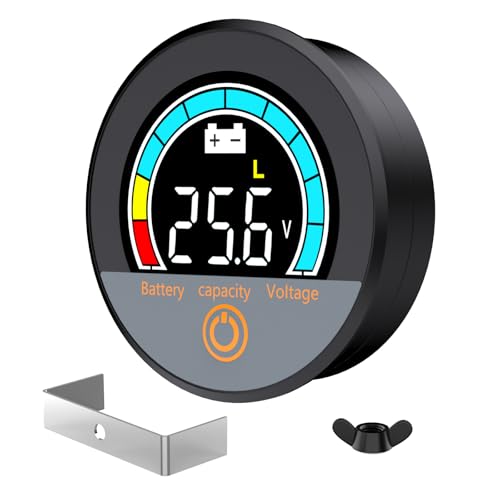
4. Malictele IP67 battery monitor — best sealed panel meter for wet cockpits
- Rating named in the listing: IP67 waterproof, backlight LCD, low-voltage alarm
- Battery families named in the listing: lead-acid, lithium, and LiFePO4
The Malictele battery monitor is the second fixed meter in this guide, and it earns a separate place because of its sealing and its chemistry range. The listing describes it as IP67 waterproof, with a backlight LCD and a low-voltage alarm, and says it supports lead-acid battery specifications at 12, 24, 36, 48, 60, 72, and 84 volts. For this keyword, only the 12-volt setting matters, but that wider range tells you the meter is built as a general battery meter rather than a single-purpose gauge. The listing also names lithium and lithium iron phosphate batteries alongside lead-acid, and lists marine equipment, RVs, solar setups, cars, motorcycles, and golf carts among its uses.
A backlit display sounds like a small detail until you try to read a battery meter in a dark cabin or under a bimini at dusk. The low-voltage alarm does the same job as on the SUPNOVA unit: it turns a slow discharge into an early warning instead of a dead bank. The IP67 rating is the headline for an open boat, a center console, or a cockpit that takes spray, because the meter itself is the part of the system that lives in the weather while the battery sits below deck.
Choose between the two panel monitors by installation and chemistry. If your boat is a straightforward 12-volt lead-acid setup and you want the temperature display and bracket format, the SUPNOVA is the closer fit. If your cockpit is wet, you want the stronger stated sealing, or your bank includes lithium chemistry, the Malictele listing is the one to read in full before ordering. With either meter, confirm the cutout or bracket dimensions against your panel before you buy, because panel instruments are only easy to fit when the hole and the body agree.
Handheld tester or fixed meter: which do you actually need?
These tools are often sold as if they were substitutes. On a boat they are partners. A handheld analyzer or load tester is a diagnostic tool. You reach for it when a battery seems weak, when you are deciding whether to replace a battery before a trip, or when you need to separate a battery problem from a starter or charging problem. It gives a verdict at a moment in time, and that verdict is detailed.
A fixed meter is a watchman. It gives a simpler picture, but it gives it continuously, and it can warn you while a problem is still cheap to fix. Boats that spend nights at anchor, run a fridge, or rely on one house bank for lights and electronics benefit most from a fixed meter, because the risk is not a single bad start. The risk is a slow, unnoticed discharge across an evening.
If you can only buy one tool first, start with the handheld tester if your starting battery is older or your cranking already sounds slow. Start with the fixed meter if your batteries are newer but your electrical use at anchor is growing. Many owners end up with both, and that is not duplication. It is diagnosis plus monitoring, which is how a battery system stays boring, and boring is what you want from a battery system on the water.
How to test a marine battery correctly
Whatever tool you choose, the test conditions decide whether the result means anything. Test a battery at rest where you can. A battery that has just come off a charger can show a surface charge that makes it look stronger than it is, and a battery that has just cranked an engine can look weaker than it is. Follow the tester maker instructions on rest time and on whether the battery should be connected or isolated.
Clean and tighten the terminals before you test, and clamp the tester onto clean metal rather than onto corrosion. On boats, cable ends and wing nuts are frequent sources of voltage drop that look exactly like a dying battery. If a tester reports a weak battery, repeat the test after cleaning the connections before you spend money on a replacement. If the battery passes on its own but the boat still cranks slowly, move on to the charging and cranking tests, and inspect the cables, because the problem may not be inside the battery at all.
Test each battery separately on a multi-battery boat. A bank tested as a single unit can hide one failing battery behind its healthier partners, and that failing battery will then drag the rest of the bank down. Label each battery with its install date, test them one by one at the start of the season, and write the results down. A short written history turns a vague feeling that a battery is getting old into a trend you can act on before it strands you.
Safety notes for testing on a boat
Battery work on a boat deserves the same respect as battery work anywhere, plus a little extra for the enclosed spaces. Work with ventilation, keep sparks and open flames away from a battery that has been charging, and wear eye protection when you are working over terminals. Remove metal jewelry, and be careful with tools around both terminals at once.
Never run a load test longer than the maker directs, and never ignore heat, swelling, a damaged case, or a strong rotten-egg smell. Those are signs to stop testing and replace or professionally inspect the battery, not signs to test it harder. If your boat has a battery switch, use it to isolate the battery you are testing, and confirm that bilge pumps wired directly to the battery still have power when you finish. A successful test that leaves an automatic bilge pump disconnected is not a successful job.
Frequently asked questions
Can I use a car battery tester on a marine battery?
Yes, when the tester is listed for marine use and matches your battery type and rating standard, as the handheld picks in this guide are. A 12-volt marine starting or dual-purpose battery is tested the same basic way as a 12-volt automotive battery. Deep-cycle house batteries still benefit from capacity monitoring, which is why the fixed meters are included here.
Does a voltage reading alone tell me a battery is good?
No. Voltage tells you about charge level at that moment, not about capacity under load. A battery can show a reasonable resting voltage and still sag badly when the starter draws current. That is the difference the cranking test, the charging test, and the Schumacher load test are designed to expose.
Which pick is best for a single starting battery?
The TOPDON BT100 is the most informative single tool for that job, because it combines the battery test with cranking and charging tests in one handheld unit. The Schumacher BT-100 is the better choice if you prefer a real load and a simple analog verdict with no menus.
Which pick is best for a house bank at anchor?
One of the two fixed monitors. Both report remaining capacity and voltage continuously and both include a low-voltage warning, which is what protects a house bank during an evening of lights, refrigeration, and electronics. Choose by sealing, display, and the battery chemistry named in each listing.
What about Bluetooth battery monitors?
Bluetooth monitors can be useful, and several are sold for boats, but check the live offer carefully before relying on any single model. Only buy a monitor whose current Amazon US listing shows it is actually available, and remember that a phone app is only helpful if the phone is aboard, charged, and within range. A fixed display keeps working for every person on the boat, which is why the panel meters made this list.
Bottom line
For a clear, detailed verdict on a 12-volt marine starting battery, choose the TOPDON BT100. For a traditional load test that shows voltage sag under a real 100-amp draw, choose the Schumacher BT-100. For everyday awareness, add a fixed meter: the SUPNOVA monitor for its temperature display, buzzer alarm, and lead-acid default, or the Malictele meter for its IP67 sealing, backlit display, and wider chemistry list. Test each battery on its own, keep the terminals clean, and let the monitor warn you early. That combination is what turns a marine battery from a surprise into a routine.