Key takeaways
- Compare the best electric bottle sterilizers for bottles, pump parts, and pacifiers, with capacity, cycle, and drying details to check before you buy.
An electric bottle sterilizer takes one repetitive kitchen task off your hands: instead of boiling a pot of water or running a partial dishwasher load, you add water, load the bottles, and let a countertop steam cycle do the work. Most models use plain steam with no added chemicals, and many add a heated drying cycle so bottles come out ready to store rather than dripping on a rack.
The five picks below cover the main shapes this category takes: a modular premium model with filtered-air drying, a simpler sterilize-only unit from the same brand family, a six-bottle design with an accessory tray, an extra-large stacked model rated for up to thirteen bottles, and an adjustable two-layer design that can also run as closed storage. Capacity and whether drying is built in are the differences that matter most.
As an Amazon Associate, we earn from qualifying purchases.
Quick Answer
For most households, a six-bottle electric steam sterilizer with a drying cycle, such as the Philips Avent Sterilizer and Dryer Premium, covers daily bottle turnover in one load. If you run more bottles or pump parts, the Papablic Pro Max stacks up to thirteen. Dr. Brown’s Deluxe suits sterilize-only simplicity, and the GROWNSY 3-in-1 adds a storage mode.
Philips Avent Baby Bottle Sterilizer and Dryer Premium (SCF293)
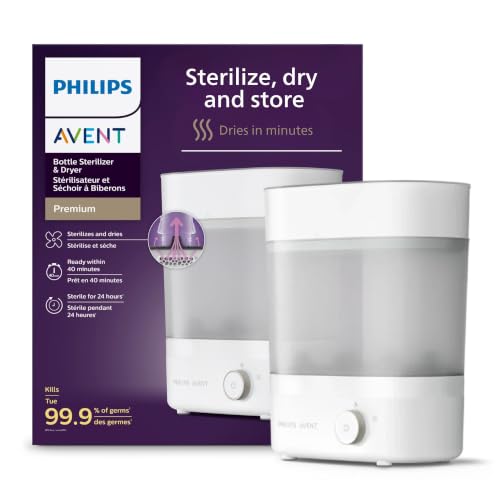
This is the full-featured option in the Philips Avent line: it sterilizes with steam and then dries with hot, filtered air, so a load comes out dry instead of needing rack time. The maker rates the drying stage at roughly forty minutes, with the steam cycle itself taking about ten minutes including heat-up.
The design is modular. Run a small configuration for pacifiers, a medium one for pump parts and toddler items, or the full stack for up to six bottles plus teats and accessories, so the footprint shrinks on partial-load days. Philips also states that contents stay sterile for up to twenty-four hours if the lid stays closed, which lets you run a load at night and use bottles through the next day. Check the listing for the maker’s current germ-reduction claim and cycle figures, since brands update these over time.
Specs
- Capacity: up to 6 bottles, plus teats and accessories
- Model: SCF293/00
- Method: electric steam, then hot filtered-air drying
- Configurations: small, medium, and large modular stacks
- Dimensions: 11.9 x 7.5 x 14.8 inches per the listing
- Sterile hold: up to 24 hours with the lid closed, per the maker
Philips AVENT Advanced Electric Steam Sterilizer (SCF291/00)

The Advanced model keeps the modular stacking idea but drops the dryer, making it the simpler route into the same bottle ecosystem. It is a sterilize-only unit: load the bottles, add water, and run a steam cycle the maker rates at about ten minutes in total, including heat-up.
Like the Premium, it adjusts between small, medium, and large configurations, so a pacifier-only run does not require assembling the full tower. The full stack holds up to six bottles, and the maker states contents remain sterile for up to twenty-four hours when the lid stays shut. Because there is no drying fan, bottles come out wet and need air-drying time on a rack, the main trade-off against the Premium. If your bottles are mostly Philips Avent shapes and you do not mind rack drying, this covers the same core job with fewer parts.
Specs
- Capacity: up to 6 bottles, plus accessories
- Model: SCF291/00
- Method: electric steam, no drying cycle
- Cycle time: about 10 minutes total per the maker
- Dimensions: 11.96 x 7.2 x 14.13 inches per the listing
- Sterile hold: up to 24 hours with the lid closed, per the maker
Dr. Brown’s Deluxe Electric Sterilizer (AC045)

Dr. Brown’s Deluxe is a straightforward six-bottle steam sterilizer. It uses a removable bottle tray sized around Dr. Brown’s own bottles while also accepting most other brands, and an accessory tray handles nipples, pacifiers, and small parts in the same run.
Practical touches set it apart from the modular towers: an automatic shut-off helps prevent the unit from running dry, and the box includes a measuring cup for filling the reservoir and tongs for handling hot items after a cycle. There is no drying function, so bottles need separate air-drying, and the one-year limited warranty is valid in the US and Canada only, per the listing. Households already using Dr. Brown’s bottles, including the Options+ parts with their extra internal pieces, get the most from the tray layout here.
Specs
- Capacity: up to 6 bottles, plus parts and pacifiers
- Model: AC045
- Method: electric steam, no drying cycle
- Features: auto shut-off, removable bottle tray, accessory tray
- Included: measuring cup and tongs
- Dimensions: 13.3 x 12.8 x 10 inches per the listing
- Weight: 5.6 pounds per the listing
- Material: BPA-free plastic per the listing
Papablic Bottle Sterilizer and Dryer Pro Max (PPL51)
The Pro Max is the capacity pick. Papablic rates it for up to thirteen bottles at once, using four adjustable stacking configurations, which suits twins, exclusive pumping, or households that batch a full day of bottles and pump parts in one run. A digital control panel shows the selected mode and remaining time, easier to read at a glance than a single dial.
Beyond sterilize and dry modes, the listing describes a five-in-one feature set that includes storage and a food-warming function for baby food jars. Papablic states that sterilized contents stay fresh for up to twenty-four hours inside the closed unit. The trade-off is size: this is the bulkiest pick here at nearly seven pounds, so measure your counter before choosing it, and confirm the assembled dimensions on the listing, since published figures vary between package and product measurements.
Specs
- Capacity: up to 13 bottles, plus accessories
- Model: PPL51
- Method: electric steam with clean-air drying
- Configurations: four adjustable stacking layouts
- Controls: digital panel with mode and time display
- Extra function: baby food warming per the listing
- Weight: 6.69 pounds per the listing
- Sterile hold: up to 24 hours per the maker
GROWNSY Adjustable 3-in-1 Bottle Sterilizer and Dryer
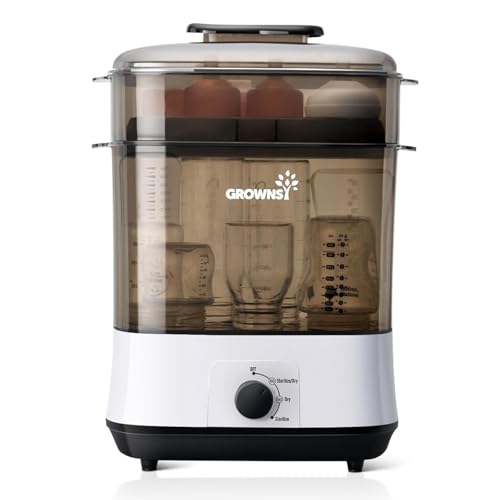
GROWNSY’s 3-in-1 takes a two-layer approach: run the main layer alone, the upper layer alone, or both together, depending on load size. Together the layers hold up to eight tall bottles, and the listing says the racks fit all major bottle brands along with pump parts, pacifiers, spoons, and teethers.
The control is a single knob, and the mode list is broader than most: sterilizer and dryer together, sterilizer only, dryer only, or a storage mode. In storage mode the unit states it keeps the load in a sterilized environment for over seventy-two hours, the longest hold claim in this group, suiting families who sterilize in big batches every few days. At under five pounds, it is also one of the easier large-capacity models to move between counter and cupboard. As with every pick here, treat the maker’s sterilization figures as the brand’s own published claims and check the listing for current wording.
Specs
- Capacity: up to 8 tall bottles, plus accessories
- Method: electric steam with drying
- Configurations: main layer, upper layer, or both
- Modes: sterilize and dry, sterilize only, dry only, storage
- Controls: one-knob operation
- Dimensions: 6.59 x 9.4 x 12 inches per the listing
- Weight: 4.66 pounds per the listing
- Power: corded electric
How to Choose
Start with capacity. Count the bottles your household cycles through in a day, then add pump parts if you pump. A six-bottle unit covers most single-baby routines; eight- and thirteen-bottle models make sense for twins, daycare prep, or batch sterilizing every other day.
Next, decide on drying. Sterilize-only units have fewer parts, but bottles come out wet and need rack space and time. A built-in dryer adds cycle time yet returns bottles ready to assemble or store, which matters for night feeds. If you choose a dryer model, check whether the air is filtered and whether replacement filters are sold for it; confirm on the listing.
Then look at layout. Modular towers shrink for small loads but have more pieces to wash and stack; fixed trays load faster but always take the same space. Measure counter depth and cabinet clearance against the listed dimensions before ordering.
Finally, check whether an accessory tray is included, whether the unit has auto shut-off, how the maker says to descale it, and the sterile-hold time claimed with the lid closed. Follow your pediatrician’s and the bottle maker’s guidance on how often to sterilize; needs differ by age and health situation, and this guide does not replace that advice.
Who Should Skip
Skip an electric sterilizer if you only sterilize occasionally, for example before first use of new bottles. A pot of boiling water or a microwave steam sterilizer handles one-off jobs without giving a permanent appliance a counter spot.
Skip the extra-large models if your kitchen is small and your daily bottle count is low; a thirteen-bottle tower you half-fill wastes space and cycle time. Skip dryer models if you already air-dry on a rack overnight. And skip the whole category if your dishwasher has a heated sanitize cycle that your bottle maker approves for its bottles and parts, since you may already own the function in another form.
FAQ
How often should bottles be sterilized?
Guidance varies by a baby’s age and health, and health authorities publish their own recommendations, so follow your pediatrician’s advice first. Many families sterilize daily during the early months and taper off later. Appliance makers also state usage suggestions in their manuals, worth reading alongside medical guidance.
Can these sterilizers handle pump parts and pacifiers?
Yes, within size limits. Every pick here lists pump parts, nipples, and pacifiers as suitable loads, usually on an accessory tray or upper layer. Check each item’s care instructions first, because some silicone and plastic parts have heat limits, and confirm tall parts fit under the lid.
Do I need to descale an electric bottle sterilizer?
In most cases, yes, periodically. Steam units heat water in a reservoir or on a plate, so mineral scale builds up, faster in hard-water areas. Makers publish descaling steps in their manuals, often using vinegar or citric acid. Distilled water can slow buildup; confirm the maker’s recommendation in the manual.
What is the difference between a sterilizer and a bottle washer?
A sterilizer steams items you have already washed; it does not remove milk residue on its own. A bottle washer is a separate, larger appliance class that washes with water jets and detergent, then sterilizes and dries. If your main problem is residue and scrubbing time, look at washers; if your bottles are already washed, a sterilizer is the right tool.
Final Verdict
For a single all-round recommendation, the Philips Avent Sterilizer and Dryer Premium pairs a six-bottle modular layout with filtered-air drying. The SCF291 Advanced trims the dryer for a simpler version of the same idea, and Dr. Brown’s Deluxe suits Dr. Brown’s bottle households that want an accessory tray and included tongs. For volume, the Papablic Pro Max handles up to thirteen bottles, while the GROWNSY 3-in-1 splits the difference with eight bottles, flexible layers, and a long storage mode. Match capacity to your daily count and decide whether drying is worth it.