Our Short List of 3

All 4 Picks at a Glance
| Product | Specs | Action |
|---|---|---|
| 1. LiTime 12V 100Ah LiFePO4 Battery, Group 31 — Best Overall Lithium | Check price on Amazon | |
 3. Renogy 12V 100Ah Deep Cycle AGM Battery — Best Proven AGM | Check price on Amazon | |
 4. WEIZE 12V 100Ah Deep Cycle AGM Battery, Group 31 — Best Value AGM | Check price on Amazon | |
 5. Mighty Max ML100-12 12V 100Ah AGM Battery — Best Compact AGM Alternative | Check price on Amazon |
Key takeaways
- The best battery for a camper van compared: LiFePO4 and AGM deep-cycle house batteries in 100Ah sizes, with usable capacity, charging, weight and fit checks.
As an Amazon Associate we earn from qualifying purchases.
Affiliate Disclosure: This article contains affiliate links. If you buy through a link on this page, we may earn a commission at no extra cost to you.
The best battery for a camper van is not the battery that starts the engine. It is the house battery, sometimes called the leisure or auxiliary battery, and its job is completely different. It sits under a seat, in a rear cabinet or in a dedicated battery box and quietly runs the compressor fridge, the LED lights, the water pump, the roof fan, the phone chargers and, through an inverter, the occasional laptop. It gets discharged deeply in the evening, recharged slowly the next day, and asked to do that again hundreds or thousands of times. A starter battery is built for short, violent bursts of current and would die young in that role. Every pick in this guide is a true deep-cycle battery in one of two chemistries, lithium iron phosphate (LiFePO4) or absorbed glass mat (AGM), because those are the two chemistries that make sense inside a living space. This guide explains how to size a van battery, what separates lithium from AGM in daily use, and which of five 100 amp-hour batteries fits which kind of build.
How Much Battery Does a Camper Van Actually Need?
Start with a simple energy audit, not with a product page. List everything the house battery will run, note roughly how many hours each item runs per day, and add the loads up in watt-hours. A modern compressor fridge is usually the single biggest load because it cycles on and off around the clock. Add a roof fan running through a warm evening, a handful of LED lights, a water pump that runs in short bursts, and phone and tablet charging, and a typical two-person van lands somewhere in the range of a few hundred watt-hours per day. A 12 volt, 100 amp-hour battery stores about 1,280 watt-hours in total on paper. What you can actually use from it depends on the chemistry. A LiFePO4 battery can be discharged deeply as a matter of routine, so most of that stored energy is genuinely available. An AGM battery lasts longest when you only use roughly the top half of its capacity, so the same 100 amp-hour rating delivers noticeably less usable energy per day. That single difference explains most of the price and weight gap between the two chemistries, and it is why one lithium 100Ah battery often replaces a pair of AGM batteries in a serious build.
If your audit says you need more than one battery can give, you have three honest options: buy a larger single battery, wire two batteries in parallel, or cut the load. Cutting the load is the option people skip and later wish they had taken. A more efficient fridge, LED lighting throughout and charging laptops from 12 volt adapters instead of an inverter all shrink the battery bank you need to buy, carry and recharge. Also think about how the battery gets refilled. Solar on the roof, a DC-DC charger fed by the alternator while driving, and a mains charger for campsite hookups are the three usual sources, and the battery you choose has to accept charge from the sources you actually have. Lithium batteries in particular need chargers with a lithium profile, and they must not be charged below freezing unless the battery has low-temperature protection or a heater, a point that matters for winter vans and is covered in the product notes below.
The 5 Best Camper Van Batteries at a Glance
All five picks are 12 volt, 100 amp-hour deep-cycle batteries, which keeps the comparison honest. Three are AGM and two are LiFePO4, and the right choice depends on your budget, your payload limit and how many nights you spend away from hookups.
- Best overall lithium: LiTime 12V 100Ah LiFePO4, Group 31
- Best cold-weather lithium: Dakota Lithium 12V 100Ah LiFePO4, Group 24
- Best proven AGM: Renogy 12V 100Ah Deep Cycle AGM
- Best value AGM: WEIZE 12V 100Ah Deep Cycle AGM, Group 31
- Best compact AGM alternative: Mighty Max ML100-12 12V 100Ah AGM
1. LiTime 12V 100Ah LiFePO4 Battery, Group 31 — Best Overall Lithium
The LiTime 12V 100Ah is the battery most van builders should look at first. Its listing describes a Group 31 LiFePO4 battery with a built-in 100 amp battery management system and a rated life of more than 4,000 deep cycles, storing 1.28 kilowatt-hours in a case that follows a familiar lead-acid footprint. For a camper van, those numbers translate into a battery you can run down hard every evening without the slow damage that deep discharge causes in lead-acid, and one that should keep doing it for many seasons of trips. The 100 amp continuous limit from the BMS is the figure to plan around: it comfortably covers a fridge, fan, lights and pump together, and it will run a modest inverter, but a large inverter pulling heavy AC loads can exceed what a single one of these batteries is allowed to deliver. Builders who want a big inverter usually solve that by putting two of these batteries in parallel, which doubles both the stored energy and the available current.
Weight is the second reason this battery suits vans. A lithium 100Ah battery is dramatically lighter than an AGM of the same rating, and in a van every kilogram saved in the battery box is a kilogram available for water, gear or simply staying inside the payload limit. The Group 31 case is larger than a Group 24 case, so measure the battery box before ordering, especially in conversions where the battery lives under a swivel seat base designed around a smaller lead-acid battery. Charging needs the usual lithium care: use a charger or DC-DC unit with a lithium profile, and respect the low-temperature limits in the manual, because this standard model is the one to choose for mild-climate travel rather than for charging in hard frost. Check the current listing before you buy, and confirm the exact terminal layout and dimensions against your tray.
2. Dakota Lithium 12V 100Ah LiFePO4 Battery, Group 24 — Best for Cold Weather
Dakota Lithium builds its 12V 100Ah battery into the smaller Group 24 footprint, at a published weight of about 27.6 pounds, and positions it for exactly the conditions that punish ordinary lithium batteries: cold mornings, rough roads and long service. Published comparisons of this model list a Group 24 case measuring roughly 10.24 by 6.65 by 8.46 inches and an unusually long manufacturer warranty for this class of battery, which is part of what you are paying for. The smaller case is a genuine advantage in a camper van, where the classic installation spots, under the driver seat in many European-style conversions or in a tight rear locker, were drawn around Group 24 lead-acid batteries. A lithium battery that drops into that same space and gives you nearly its full nameplate capacity as usable energy is a very easy upgrade to justify on a winter trip.
The cold-weather angle deserves care rather than slogans. No LiFePO4 battery should be charged below freezing unless it has protection that prevents it or a heater that warms the cells first, so check the current product documentation for this exact model and follow it, and consider where the battery sits in the van: a battery inside the heated living space warms up with the cabin, while one in an unheated external locker can stay at ambient temperature all night. Dakota Lithium’s published materials emphasise cold-climate use, which is why this pick is listed for four-season vans, but the safe routine is the same for every lithium pick here: let the battery warm before charging, or rely on the protection the maker built in. If your van lives in a warm climate and never sees frost, the extra money this battery asks is harder to justify than the LiTime above. If you ski from your van, it is the pick written for you.
ASIN: B08N57HR2K
3. Renogy 12V 100Ah Deep Cycle AGM Battery — Best Proven AGM
Not every van should go lithium, and the Renogy Deep Cycle AGM is the strongest argument for staying with lead-acid. The listing describes a 12 volt, 100 amp-hour AGM battery with a maximum discharge current of 1,100 amps, a low self-discharge rate of about three percent per month, and a sealed, maintenance-free design, under the manufacturer model number RNG-BATT-AGM12-100. AGM batteries tolerate the charging equipment many vans already have: a basic split-charge relay, an older mains charger or a solar controller with only lead-acid profiles will all charge this battery without the profile worries that come with lithium. It also shrugs off cold charging in a way lithium cannot, which matters for simple winter builds. And because it is sealed, it can be mounted in the living space without the venting concerns of a flooded battery, though it still needs to be secured properly, because it is heavy.
That weight is the honest downside. A 100Ah AGM weighs roughly two to three times what the lithium picks here weigh, and you should only plan to use about half of its rated capacity if you want it to last, so the usable energy per kilogram is far lower. In practice that means this battery suits weekend and holiday vans, vans that return to a hookup regularly, and builders whose budget is better spent on insulation, windows or a heater than on the battery bank. Renogy is also a familiar name in small off-grid systems, so documentation, compatible chargers and solar controllers are easy to find from the same maker. Treat it gently, recharge it promptly after trips, do not leave it sitting discharged, and an AGM like this gives dependable service. Abuse it with repeated deep discharges and it will fade early, as every AGM does.
4. WEIZE 12V 100Ah Deep Cycle AGM Battery, Group 31 — Best Value AGM
The WEIZE 12V 100Ah Deep Cycle AGM offers the same basic proposition as the Renogy, a sealed 100 amp-hour lead-acid house battery, in a Group 31 case and usually as the lower-outlay option of the two. Its listing describes a maintenance-free AGM battery with a maximum discharge current of 1,150 amps and the same low, roughly three percent monthly self-discharge figure quoted for its Renogy rival. For a camper van, the practical reading is simple: this is a battery for a straightforward 12 volt system, fridge, lights, fan and pump, charged by the alternator, solar or a hookup charger, with no special lithium settings anywhere in the system. The Group 31 case is a common size in larger vans and RV-style conversions, but it will not fit every under-seat battery box, so the tape measure matters more than the brand name here.
Choosing between this and the Renogy is mostly a question of support and documentation rather than chemistry, because on paper the two are close. Buyers who want the deeper catalogue of matching chargers and controllers will lean Renogy; buyers who want the same class of battery for a simple build and would rather put the savings toward a second battery, a better fridge or a DC-DC charger will lean WEIZE. Whichever AGM you choose, the care rules are identical: keep it charged in storage, avoid running it flat, size your daily loads to roughly half its rating, and secure it against movement, because a battery this heavy becomes a hazard in a crash if it is merely sitting in a locker. As a first battery for a first conversion, this is a sensible, unglamorous place to start, with a clear upgrade path to lithium later using the same wiring and the same space, once you have changed the charger settings to suit.
5. Mighty Max ML100-12 12V 100Ah AGM Battery — Best Compact AGM Alternative
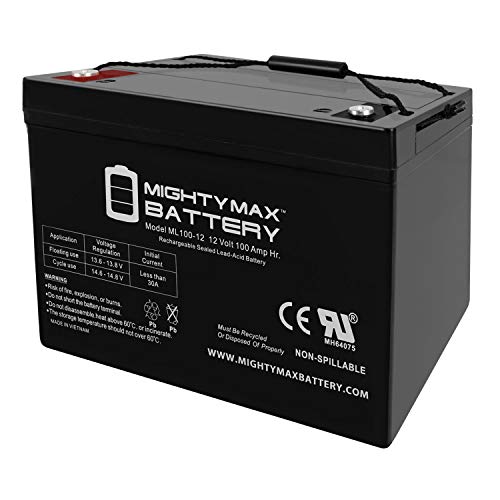
The Mighty Max ML100-12 is the third AGM in this guide, and it earns its place as the alternative to check when the Renogy or WEIZE case sizes do not fit your battery box, or when you are replacing an existing 100Ah sealed lead-acid battery and want a like-for-like swap. It is a 12 volt, 100 amp-hour sealed AGM battery sold for exactly this family of jobs: RV and van house power, solar storage, and backup duties. Its specifications follow the familiar AGM pattern, so everything said above about usable capacity applies here too. Plan your daily loads around roughly half the nameplate rating, recharge promptly, and expect a service life measured in hundreds of cycles rather than the thousands claimed by the lithium picks.
Where a battery like this makes particular sense is in an older conversion that already works. If your van has a functioning split-charge system, a lead-acid solar profile and wiring sized for an AGM, dropping in a fresh ML100-12 restores the system you have for the least disruption, and it can be mounted in any orientation except upside down, as sealed AGM batteries generally can. It is also a reasonable choice for a van that is charged almost entirely while driving, where the alternator does the work and the battery mainly bridges evenings and overnight stops. Do the same checks you would for any pick here: measure the box, confirm the terminal type matches your cables, and verify the current listing details before ordering, because commodity AGM batteries are sold under many near-identical listings and the exact case and terminals are what decide whether your swap is easy or annoying.
LiFePO4 or AGM: Which Should Your Van Get?
The decision reduces to four questions. First, how much usable energy do you need each day? The bigger the daily load and the longer you stay off hookups, the stronger the case for lithium, because its usable capacity per battery is roughly double an AGM of the same rating. Second, what does your van’s payload allow? Lithium saves a large amount of weight per battery, which matters in small vans that are close to their limit once water, fuel and people are aboard. Third, what charging equipment do you already own? A van wired and configured for lead-acid can accept an AGM today with no other changes, while lithium may ask for a charger with the right profile and a plan for cold mornings. Fourth, how long will you keep the van? Lithium costs more up front and repays it over a long service life of deep daily cycles; AGM costs less up front and suits lighter use. None of these answers is wrong. The wrong answer is the one that ignores the questions, a lithium battery charged by equipment that cannot charge it properly, or an AGM bank so undersized that it is run flat every night and replaced every year.
Installation and Safety Notes That Apply to Every Pick
Secure the battery mechanically, not just electrically: it should be strapped or clamped in a tray or box that keeps it in place under braking and on rough tracks. Fuse the main positive cable close to the battery, size cables for the inverter if you have one rather than for the fridge, and keep the battery away from heat sources such as diesel heaters and exhaust runs. If you charge from the alternator, a proper DC-DC charger is strongly recommended for lithium batteries and is kinder to AGM batteries than a plain relay, because it delivers the controlled voltage each chemistry wants and protects the starter battery from being drained. Never let the house system draw from the starter battery while parked, and never charge a lithium battery below freezing unless its documentation explicitly allows it. Finally, re-check the exact specifications, dimensions and terminal layout on the current product listing before you order. Battery listings are revised, group sizes vary between near-identical models, and the cheapest mistake in a van build is a battery that almost fits.
Verdict
For most camper van builders, the LiTime 12V 100Ah LiFePO4 is the best battery for a camper van: deep usable capacity, a built-in 100 amp management system and lithium’s low weight in a standard Group 31 case. Cold-climate travellers should look at the Dakota Lithium Group 24 instead. If your build, budget or existing chargers point to lead-acid, the Renogy AGM is the proven choice, the WEIZE AGM is the value choice, and the Mighty Max ML100-12 is the swap-in alternative. Size the bank from your daily loads, not from a headline, and any of these five will run a van’s house system honestly.