Our Short List of 3

- Best for: everyday full-bottle reds at home.
- Capacity: 750 ml, sized for one standard bottle
- Material: hand-blown lead-free crystal glass
- Aeration: built-in aerator design
- Spout: slanted easy-pour spout
- Best for: older bottles where sediment control matters.
- Model: Cabernet Decanter 1440/13
- Material: machine-made crystal glass
- Recommended volume: 750 ml (25 oz)
- Height: 9.06 in

- Best for: entertaining, magnums and double bottles.
- Capacity: 64.5 fl oz
- Material: hand-blown lead-free crystal
- Origin: hand-crafted in Europe
- Stopper: crystal ground stopper included
All 5 Picks at a Glance
| Product | Specs | Action |
|---|---|---|
| Le Chateau Crystal Wine Decanter |
| Check price on Amazon |
| Riedel Cabernet Wine Decanter |
| Check price on Amazon |
| Ravenscroft Large Wine Decanter |
| Check price on Amazon |
 Godinger Wine Decanter Carafe |
| Check price on Amazon |
 YouYah Wine Decanter Set |
| Check price on Amazon |
Key takeaways
- Compare five of the best wine decanters for aeration, sediment control and clean pours, from hand-blown crystal carafes to a dishwasher-safe pick.
A decanter earns its place on the table in two specific moments: when a young red tastes tight and tannic straight from the bottle, and when an older bottle carries sediment you want left behind in the glass. Choosing one comes down to capacity, base width, how the neck pours, and whether cleaning it will be a chore you quietly avoid. Get those four things right and the shape on the shelf matters far less than the ritual at dinner.
This guide is for home drinkers who open anything from weeknight blends to cellared bottles saved for guests. The five picks below were chosen from their Amazon listing titles and specifications, and they cover distinct jobs: an everyday full-bottle carafe, a dishwasher-safe sediment handler, a large format piece for entertaining, a simple open carafe, and a complete set with its own stand and aerator lid.
Quick Picks
As an Amazon Associate we earn from qualifying purchases
| Product | Best for | Key spec from title |
|---|---|---|
| Le Chateau Crystal Wine Decanter | Everyday full-bottle reds | Hand-blown lead-free crystal, 750 ml |
| Riedel Cabernet Wine Decanter | Dishwasher-safe sediment control | Machine-made crystal, model 1440/13 |
| Ravenscroft Large Wine Decanter | Entertaining and magnum bottles | 64.5 fl oz with crystal ground stopper |
| Godinger Wine Decanter Carafe | A simple open carafe for reds and whites | Hand-blown lead-free crystal, 750 ml |
| YouYah Wine Decanter Set | A complete set with stand and aerator lid | 1400 ml with stainless steel pourer lid |
How to Choose
Capacity and the Bottle You Actually Open
Most home drinkers decant one standard 750 ml bottle at a time, and a decanter sized for exactly that spreads the wine at its widest point without leaving it swimming in a half-empty vessel. If you regularly open magnums or pour for a table of six, a large format decanter in the 1400 ml to 1900 ml range keeps the whole bottle in one vessel. Match the vessel to your real habit, because an oversized decanter used for a single bottle exposes more wine to air than the evening calls for.
Base Width and Aeration Speed
The wider the base, the more wine surface touches air, and the faster a young, firm red softens. A broad, flat-bottomed carafe is the right call for tannic wines you plan to drink within the hour. Narrower, taller shapes aerate gently and suit delicate older bottles where the goal is separating sediment rather than waking the wine up. Think about which problem you solve more often, then let the silhouette follow from that answer instead of from looks alone.
Neck, Spout and Pour Control
A slanted or angled opening does quiet, practical work: it guides the stream into the glass and cuts down on the drip that runs down the outside of the vessel. Built-in aerator lids and filter pourers add a second pass of air as you serve, which helps young wines but adds a part that needs washing and careful handling. If you decant older bottles, a plain open neck gives you a clearer view of sediment approaching the shoulder as you pour.
Cleaning, Drying and Storage
Narrow necks look elegant and then defeat every brush you own. Check whether the maker rates the piece dishwasher safe, whether a drying stand is included or sold for the shape, and how tall the decanter stands against your cabinet shelves. Hand-blown crystal rewards gentle hand washing and air drying on a stand, while machine-made crystal tolerates more routine handling. A decanter that is annoying to clean gets used twice and then lives in its box.
The 5 Best Options
Le Chateau Crystal Wine Decanter
- Best for: everyday full-bottle reds at home.
- Capacity: 750 ml, sized for one standard bottle
- Material: hand-blown lead-free crystal glass
- Aeration: built-in aerator design
- Spout: slanted easy-pour spout
everyday full-bottle reds at home.
hand-blown glass varies slightly piece to piece, so inspect the lip and base for chips or bubbles when it arrives.
This is the decanter to reach for when one good bottle anchors a weeknight dinner and you want the pour to feel deliberate without turning into a ceremony. The wide base spreads a full bottle across a broad surface for steady aeration, the integrated handle gives a secure grip on a full vessel, and the slanted spout keeps the stream aimed at the glass. Its footprint is compact enough for a crowded table, and the listing rates it dishwasher safe, which removes the usual excuse for leaving it in the cupboard.
Riedel Cabernet Wine Decanter
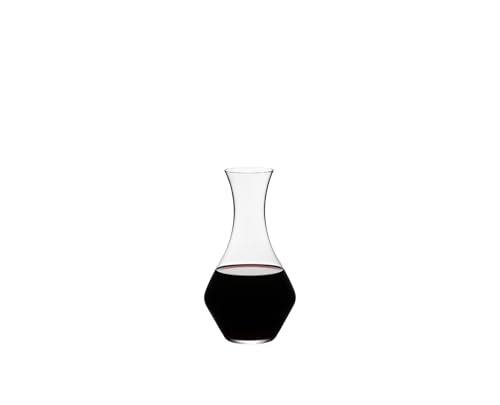
- Best for: older bottles where sediment control matters.
- Model: Cabernet Decanter 1440/13
- Material: machine-made crystal glass
- Recommended volume: 750 ml (25 oz)
- Height: 9.06 in
older bottles where sediment control matters.
the narrow neck limits brush access, so plan on a bottle cleaner or cleaning beads for the inside.
Riedel built this machine-made decanter, model 1440/13, around careful service of a single bottle, and its angular shape leaves sediment behind in the shoulder as you pour slowly. At just over nine inches tall with a narrow footprint, it fits shelves and cabinets that rule out wider carafes. The maker rates it dishwasher safe, a practical detail that separates it from most hand-blown pieces, and the light 290 gram body stays easy to handle even when full. It is the precision option here rather than the statement piece.
Ravenscroft Large Wine Decanter
- Best for: entertaining, magnums and double bottles.
- Capacity: 64.5 fl oz
- Material: hand-blown lead-free crystal
- Origin: hand-crafted in Europe
- Stopper: crystal ground stopper included
entertaining, magnums and double bottles.
a full vessel is heavy and needs two hands and a clear path from counter to table, so check your serving routine first.
When the table seats eight and the bottle is a magnum, a single-bottle carafe runs out halfway through the pour, and that is the gap this large European-made decanter fills. Its 64.5 fl oz capacity takes big formats in one vessel, the wide base gives a generous aeration surface, and the crystal ground stopper lets you cover the wine between courses instead of leaving it open to the room. It arrives gift-boxed and carries the visual weight of a centerpiece, so it suits hosts who treat decanting as part of the presentation.
Godinger Wine Decanter Carafe
- Best for: a straightforward carafe for mixed red and white drinking.
- Capacity: 750 ml, holds one full bottle
- Material: hand-blown lead-free crystal
- Design: open carafe with wide base
- Opening: slanted top for controlled pouring
a straightforward carafe for mixed red and white drinking.
the open top has no stopper, so plan to finish the bottle the same evening rather than storing wine in it.
Godinger keeps this carafe deliberately simple: an open, wide-based vessel with a slanted top, no aerator insert, no lid mechanism, nothing between you and the pour. That simplicity is the appeal for drinkers who decant both reds and whites and want one piece that rinses clean in seconds. The hand-blown lead-free crystal holds a full bottle at its widest point, and the angled opening doubles as a comfortable grip when the vessel is full. It reads as classic tableware rather than bar equipment, which helps it blend into an ordinary dining room.
YouYah Wine Decanter Set
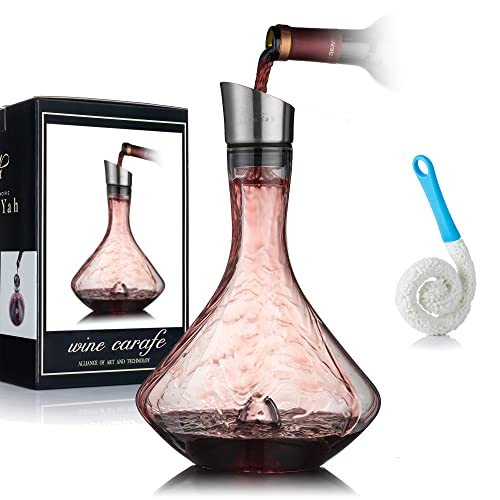
- Best for: a first decanter bought as a complete, gift-ready set.
- Capacity: 1400 ml
- Material: hand-blown lead-free crystal glass
- Lid: stainless steel pourer lid with filter
- Aerator: built-in aerator pourer
a first decanter bought as a complete, gift-ready set.
the aerator lid is a separate part that needs gentle handling during washing, and replacement lids are not sold on their own.
This set answers the two annoyances that follow most decanter purchases: where the aeration happens and where the wet vessel dries afterward. The stainless steel pourer lid carries a built-in aerator and filter, so wine gets a pass of air and a screen against sediment as it leaves the bottle, and the included drying stand holds the hand-blown vessel upside down between uses. At 1400 ml it covers a magnum or two standard bottles, which makes it a tidy single purchase for someone building a home bar from scratch.
Which One Fits Your Situation
You Open One Good Red on Weeknights
The Le Chateau matches the rhythm of a single bottle with dinner: wide base for a steady hour of air, a handle for a confident pour, and a listing that allows the dishwasher afterward. The Godinger carafe covers the same job with fewer features if you prefer an open vessel you can rinse and shelve in seconds.
You Serve Older Bottles with Sediment
Choose the Riedel Cabernet. Its angular body and narrow shoulder help you pour slowly and stop before sediment reaches the neck, and its compact height suits careful, deliberate service. The YouYah set is the alternative when you want a filter in the lid doing part of that separation work for you.
You Host Dinners and Pour for a Crowd
The Ravenscroft is the only pick here sized for magnums and double bottles without splitting the wine across two vessels, and its stopper covers the wine between courses. Hosts who open two standard bottles instead can use the YouYah set, whose 1400 ml capacity and drying stand keep service and cleanup in one footprint.
You Want One Gift-Ready Purchase
Both the Ravenscroft and the YouYah set arrive presentation-ready, the first gift-boxed as a single European-made piece, the second as a complete kit with stand and aerator lid. Pick the Ravenscroft for a traditional table, and the YouYah for a newer home bar that needs the accessories as much as the vessel.
Common Mistakes
- Decanting every bottle for hours, when delicate older wines can fade within the first hour of air exposure.
- Filling a large format decanter with a single bottle, which spreads the wine thin and speeds aeration past the point you wanted.
- Pouring the last of an older bottle in one motion and carrying the sediment straight into the final glass.
- Washing hand-blown crystal with hot water and a stiff brush, then stacking it wet where the lip can chip.
- Storing leftover wine in an open decanter overnight instead of returning it to the bottle or a stoppered vessel.
Frequently Asked Questions
How long should red wine sit in a decanter?
Young, tannic reds usually benefit from one to two hours of air, while lighter wines may need only thirty minutes. Older bottles call for a shorter rest, since their aromatics fade faster. Taste as you go rather than following a fixed clock, and pour once the wine smells open.
Does a decanter work for white wine too?
Yes, though the goal changes. Whites rarely need long aeration, but a brief rest in a carafe can soften sharp acidity and open aromatics, and the vessel makes table service easier. The Godinger carafe in this guide is listed for both red and white wines for exactly that reason.
How do I clean a narrow-neck decanter?
Rinse with warm water soon after use so residue never dries on the glass. For narrow necks, cleaning beads or a flexible bottle brush reach where a sponge cannot, and a drying stand keeps the vessel inverted so water drains fully. Avoid harsh detergents, which can leave aromas behind.
What is the difference between crystal and regular glass decanters?
Crystal is worked thinner and clearer than ordinary glass, which is why decanters made from it show the color of the wine so sharply and ring when tapped. Lead-free crystal keeps that clarity without lead in the composition. Regular glass is thicker, heavier and usually cheaper, but pours the same wine.