Our Short List of 3

- Best for: first-time correction on a daily driver, worked by hand or with a dual-action polisher.
- Size: 15.2 fluid ounces
- Part number: G17216
- Abrasive: micro-abrasive formula; grit material listed as aluminum oxide or silicon carbide
- Grit type: Fine

- Best for: heavy oxidation, deep swirls and sanding marks left by paint repairs.
- Size: 8 ounces
- Model: M10508
- Abrasive: aluminum oxide micro-abrasives
- Cut range: removes 1200-grit or finer sanding marks

- Best for: one-step correction of swirls and oxidation with minimal cleanup afterwards.
- Size: 8 ounces
- Abrasive: aluminum oxide; grit material listed as ceramic
- Grit type: Fine; grit number 1500 in the product information
- Formula: hybrid cutting compound and finishing polish, zero-dust
All 4 Picks at a Glance
| Product | Specs | Action |
|---|---|---|
| Meguiar’s Ultimate Compound, 15.2 Oz |
| Check price on Amazon |
| Meguiar’s Mirror Glaze M105 Ultra-Cut Compound, 8 Oz |
| Check price on Amazon |
| 3D One Hybrid Rubbing Compound and Polish, 8 Oz |
| Check price on Amazon |
 Chemical Guys V Line Polish and Compound Kit, 4 x 16 Oz |
| Check price on Amazon |
Key takeaways
- Compare four automotive polishing compounds by cut level, abrasive type and bottle size, from one-step hybrids to a heavy-cut formula for deep swirls.
The real decision in buying a polishing compound is how much clear coat you are willing to remove. Every compound works by leveling the surface, so a bottle that is too mild wastes an afternoon polishing over swirls, while one that is too strong cuts through finish you cannot replace. The listings make that choice concrete: they state the defect range, the sanding marks each formula can erase, and whether it works by hand or needs a machine.
This guide is for owners correcting a daily driver at home, detailers facing neglected paint, and anyone planning a staged correction with more than one bottle. The four picks below were chosen from their Amazon listings: the product name, the stated abrasive and cut range, the bottle size and the application method each maker publishes. Where a listing leaves a figure unpublished, the guide says so instead of guessing.
Quick Picks
As an Amazon Associate we earn from qualifying purchases
| Product | Best for | Key spec from title |
|---|---|---|
| Meguiar’s Ultimate Compound | Everyday swirls and water spots | 15.2 oz, fine micro-abrasive |
| Meguiar’s Mirror Glaze M105 | Heavy defects and sanding marks | Levels 1200-grit sanding marks |
| 3D One Hybrid Compound and Polish | One-step cut and finish | Ceramic grit, zero-dust formula |
| Chemical Guys V Line Kit | Staged multi-bottle correction | Four 16 oz bottles, V32 to V38 |
How to Choose
Match the Cut Level to the Defect
Cut is the whole decision. A compound earns its place by removing a thin layer of clear coat, so the right bottle is the mildest one that still levels your defect. Light wash swirls and water spots need only a fine, finishing-style compound. Heavy oxidation, deep swirls and sanding marks need an ultra-cut formula, and the listings state that reach in grit terms, from 1200-grit marks at the heavy end to 2500-grit marks for a cutting polish. Start mild on a test panel, inspect under a strong light, and step up only if the marks survive.
One Bottle or a Staged System
A one-step hybrid cuts and finishes in the same pass, which halves the work and suits owners who want the car back the same day. A staged system splits the jobs: a heavy compound levels the defect, then a finer polish removes the haze the first step leaves. Staged work reaches a cleaner finish on badly worn paint, but it doubles your bottles, pads and time. Decide by the paint in front of you, not by ambition: most daily drivers need one step, while a neglected finish repays the full sequence.
Abrasive Type and Paint Compatibility
Listings name the abrasive when the maker publishes it: aluminum oxide is the common cutting mineral, some hybrids add a ceramic grit, and diminishing abrasives break down during a pass so the cut softens as you work. Fixed, coarse abrasives cut faster but demand a second, finer step. Compatibility matters just as much. Most of these formulas are listed for clear coat and glossy paint; single-stage and lacquer finishes appear on only a few listings, so check the stated paint types before using any compound on an older car or a repaint.
Bottle Size and How You Will Apply It
Size the bottle to the job. An 8 ounce bottle covers spot correction and one smaller car; 15 to 16 ounces handles a full correction with product to spare; a four-bottle kit only makes sense when you plan several staged passes. Application matters too. Some compounds are listed for hand or machine use, which lets you test a panel before buying a polisher, while the heavy professional formulas are machine products meant for a rotary buffer or dual-action machine. Match the bottle to the tool you actually own, not the one you might buy.
The 4 Best Options
Meguiar’s Ultimate Compound, 15.2 Oz
- Best for: first-time correction on a daily driver, worked by hand or with a dual-action polisher.
- Size: 15.2 fluid ounces
- Part number: G17216
- Abrasive: micro-abrasive formula; grit material listed as aluminum oxide or silicon carbide
- Grit type: Fine
first-time correction on a daily driver, worked by hand or with a dual-action polisher.
the cut is a medium one, so deep sanding marks belong to a heavier compound, and it leaves no protection behind, so seal the paint afterwards.
Ultimate Compound is the bottle most home detailers should start with, because its micro-abrasive formula cuts quickly at the start of a pass and then refines as the abrasives break down, so the same product removes swirls and leaves gloss behind. It works by hand on a single panel or with a dual-action polisher across a whole car, and the listing rates it for clear coat and single-stage paint. The 15.2 ounce bottle is sized for several full corrections rather than one small repair.
Meguiar’s Mirror Glaze M105 Ultra-Cut Compound, 8 Oz
- Best for: heavy oxidation, deep swirls and sanding marks left by paint repairs.
- Size: 8 ounces
- Model: M10508
- Abrasive: aluminum oxide micro-abrasives
- Cut range: removes 1200-grit or finer sanding marks
heavy oxidation, deep swirls and sanding marks left by paint repairs.
the cut is fast enough to leave haze that a finer polish should refine, and the small bottle disappears quickly across a large vehicle.
Mirror Glaze M105 is the heavy end of this list, built for paint that a mild compound would only polish over. Meguiar’s rates it for moderate to heavy defects, including scratches, heavy swirls, oxidation and acid rain marks, and it levels sanding marks as fine as 1200 grit. That cutting speed comes from aluminum oxide micro-abrasives, and the formula is made for machine work with a rotary buffer or dual-action polisher. The 8 ounce bottle is a professional size, aimed at one serious correction rather than a shelf of upkeep.
3D One Hybrid Rubbing Compound and Polish, 8 Oz
- Best for: one-step correction of swirls and oxidation with minimal cleanup afterwards.
- Size: 8 ounces
- Abrasive: aluminum oxide; grit material listed as ceramic
- Grit type: Fine; grit number 1500 in the product information
- Formula: hybrid cutting compound and finishing polish, zero-dust
one-step correction of swirls and oxidation with minimal cleanup afterwards.
8 ounces runs out fast on a large vehicle, and the hybrid compromise will not match a dedicated heavy compound on severe defects.
3D One collapses two steps into one bottle: it is a hybrid that cuts like a rubbing compound and then finishes like a polish, so a single pass handles correction and gloss together. The abrasive blend pairs aluminum oxide with a ceramic grit, and the maker describes a zero-dust formula with a long working time, which matters on large panels. It can be worked by hand or with a dual-action polisher, and the 8 ounce bottle suits spot correction and smaller cars better than whole fleets.
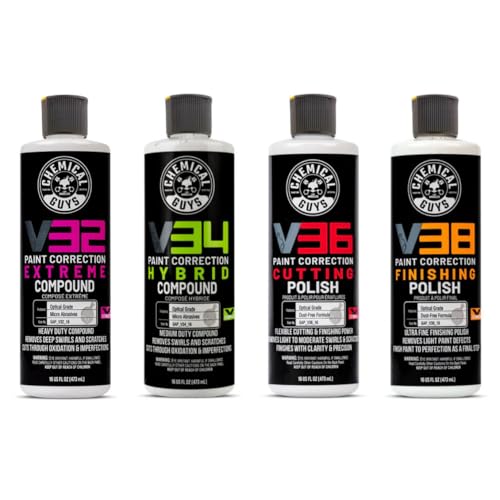
Chemical Guys V Line Polish and Compound Kit, 4 x 16 Oz
- Best for: a planned multi-stage correction on a keeper car or a dark, neglected finish.
- Contents: four 16 fl oz bottles; kit part GAP_VKIT_16
- V32 Optical Grade Extreme Compound: heavy cutting stage
- V34 Optical Grade Hybrid Compound: medium-heavy defects
- V36 Optical Grade Cutting Polish: removes 2000 to 2500 grit sanding scratches, swirls and holograms
a planned multi-stage correction on a keeper car or a dark, neglected finish.
four bottles plus matching pads add up in time and storage, and the strongest stage is easy to overwork on thin or aged paint.
The V Line kit is the staged route: four 16 ounce bottles that step down from the V32 extreme compound through the V34 hybrid compound and the V36 cutting polish to the V38 final polish. Each stage uses diminishing abrasives, so the heavy bottle levels defects and the later bottles erase the marks the earlier ones leave. V36 alone is listed for 2000 to 2500 grit sanding scratches, swirls and holograms. This is the pick for a planned full correction on a car you intend to keep, worked with a machine.
Which One Fits Your Situation
Your Daily Driver Is Covered in Wash Swirls
Start with Meguiar’s Ultimate Compound. Its fine micro-abrasive formula is listed for hand or machine use, so you can work one fender by hand on a weekday evening and judge the result before committing to a polisher. It removes swirls, water spots and light oxidation in one step and leaves gloss behind, and the 15.2 ounce bottle covers the whole car with plenty left for the next season.
The Paint Is Neglected, Oxidized and Rough
Reach for the M105 Ultra-Cut Compound. It is the strongest cutter here, listed for moderate to heavy defects and sanding marks as fine as 1200 grit, which is the territory of chalky oxidation, deep swirls and body-shop repairs. Work it by machine in small sections, then refine the finish with a finer polish, because a cut this fast is not meant to be the last step on its own.
You Want One Bottle and One Afternoon
Pick 3D One. The hybrid formula cuts and finishes in a single pass, so there is no second bottle, no second pad and no haze to chase afterwards. Its zero-dust behavior keeps the panels cleaner while you work, and it goes on by hand or with a dual-action polisher. The 8 ounce size fits a compact or mid-size car corrected panel by panel.
You Are Planning a Full Multi-Stage Correction
Buy the Chemical Guys V Line Kit. Four staged bottles let you start exactly as coarse as the paint demands, from the V32 extreme compound down to the V38 final polish, instead of forcing one formula to do every job. It suits a keeper car, a dark finish that shows every mark, or paint you plan to correct once and then maintain gently for years.
Common Mistakes
- Starting with the strongest compound on the shelf instead of the mildest one that levels the defect, which removes clear coat you cannot put back.
- Skipping the test panel: always work a small, low area first and inspect it under a strong light before doing the whole car.
- Chasing a scratch you can catch with a fingernail; marks that deep run through the clear coat and sit beyond what polishing should remove.
- Working in direct sun or on a hot panel, which dries the product out and shortens its working time.
- Forgetting that a compound leaves bare paint behind: follow with a wax or sealant, because the correction step adds no protection of its own.
Frequently Asked Questions
What is the difference between a polishing compound and a polish?
A compound carries a heavier abrasive load and is made to level defects: swirls, scratches, oxidation and sanding marks. A polish uses finer abrasives to refine the surface and raise gloss after the defect is gone. Many bottles blur the line, and hybrids do both jobs in one pass, but the working rule holds: compound corrects, polish refines.
Can I use a polishing compound by hand, or do I need a machine?
Some compounds are listed for hand or machine use, and those are the ones to buy if you do not own a polisher. Hand work suits single panels, door handle scuffs and small repairs. Heavy professional compounds are machine formulas: their cut depends on the speed and pressure of a rotary or dual-action machine, and hand rubbing rarely works them long enough.
Will a polishing compound remove deep scratches?
Only scratches that sit inside the clear coat. A compound levels the surface around a shallow scratch until the edge disappears, and listings state that reach in sanding terms, from about 1200 grit at the heavy end to 2500 grit for a cutting polish. If your fingernail catches in the scratch, the damage is deeper than a compound should chase.
Do I need to wax or seal the paint after compounding?
Yes. A compound strips the surface back to bare, corrected paint and leaves nothing protective behind, so the finish you just created is exposed to water, road film and ultraviolet light. Follow with a wax or sealant once the correction is done. Some one-step hybrids add a little gloss, but the listings still treat protection as a separate step.