Key takeaways
- Compare five aquarium water pumps by flow rate, lift height, wattage and fittings, and find the right submersible pump for your fish tank or fountain.
An aquarium pump looks like a simple purchase until the tank is running. Flow that is too strong pushes fish around and stirs up the substrate, while flow that is too weak leaves dead spots where waste settles and oxygen stays low. The right pump has to match the tank, the filter or fountain it feeds, and the height the water must climb. Getting those three things right matters more than chasing the biggest flow number on the box.
This guide is for freshwater and saltwater tank keepers, pond and fountain owners, and anyone who needs a pump for regular water changes. The five pumps below were chosen from Amazon listings by flow rate, lift height, wattage, and included fittings, covering small tabletop tanks up to larger setups that need serious circulation. Each entry lists only specifications shown on its Amazon product page, so you can compare the numbers directly.
Quick Picks
As an Amazon Associate we earn from qualifying purchases.
| Product | Best for | Key spec from title |
|---|---|---|
| VIVOSUN 800GPH Submersible Pump | Large tanks and high-lift setups | 800 GPH, 24W |
| KEDSUM 660GPH Submersible Pump | Strong all-round circulation | 660 GPH, 55W |
| hygger 400 GPH Quick Water Change Pump | Draining and refilling tanks | 400 GPH, 40W |
| PULACO 400GPH Submersible Pump | Ready-to-run setups with tubing included | 400 GPH, 25W |
| Uniclife 80 GPH Submersible Pump | Small tanks and gentle features | 80 GPH, 4W |
How to Choose
Match flow rate to tank size
Flow rate, measured in gallons per hour, is the first number to check, but it only helps when it fits the tank. A pump rated far above what the tank needs creates a current that stresses fish and keeps substrate moving. A pump rated too low leaves corners unstirred and lets debris collect on the bottom. As a starting point, look for a pump whose maximum flow suits the tank volume and the job at hand, whether that is driving a filter, running a fountain, or moving water during a change. Remember that the listed flow is a maximum measured with little or no lift, so real output in a working tank will be lower.
Check lift height, not just flow
Lift height is the maximum height a pump can push water above the water surface, and it matters as much as flow rate. A pump that moves plenty of water at tank level may deliver only a trickle once it has to push water up to a sump, a tall fountain, or a filter sitting above the tank. Measure the vertical distance from the pump to the highest point the water must reach, then add a margin for bends, valves, and narrow tubing, all of which reduce output. If your setup lifts water more than a few feet, choose a pump whose listed maximum lift clears that height comfortably rather than one that only just reaches it.
Look at wattage and running costs
Wattage tells you how much electricity a pump draws, and since many aquarium pumps run around the clock, small differences add up over months of use. A lower-wattage pump that still delivers the flow and lift you need is usually the better long-term choice, especially for a filter or circulation pump that never switches off. Compare wattage only between pumps with similar flow and lift, because a high-flow pump will naturally draw more power than a small one. Also check whether the pump offers adjustable flow, which lets you turn output down for feeding or for delicate fish without buying a second pump.
Check fittings, cord length, and cleaning access
The details around the pump decide how easy it is to live with. Check that the outlet nozzles or barb fittings match the tubing you already own, or be ready to buy adapters, since a mismatched outlet can turn a quick install into a hardware-store trip. Cord length matters too: the pump must reach an outlet safely without the cord hanging taut across the tank, and a short cord limits where the pump can sit. Finally, look for a pump that comes apart for cleaning, because impellers collect algae, grit, and debris over time, and a pump that cannot be opened is much harder to keep running quietly and well.
The 5 Best Options
VIVOSUN 800GPH Submersible Pump (3000L/H, 24W)

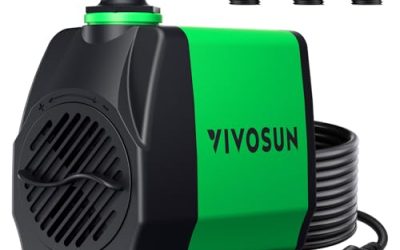
The VIVOSUN 800GPH is the strongest pump in this guide, built for keepers who need to move a lot of water or push it a long way uphill. Its 800 GPH maximum flow and 10-foot maximum lift make it a natural fit for large tanks, sump returns, and tall fountains where smaller pumps run out of reach. Despite that output, it draws only 24 watts, which keeps it efficient for a pump of this capacity. Three included nozzles help it connect to different tubing sizes, and the adjustable flow knob lets you dial the output back when full power is more than the tank needs.
Specs
- Maximum flow rate: 800 GPH (3000 L/H)
- Maximum lift height: 10 feet
- Wattage: 24W
- Voltage: 110-120V
- Power cord length: 6.5 feet
- Includes 3 nozzles
- Dimensions: 4.33 x 2.87 x 3.68 inches
- Material: Plastic
- Style: Submersible
Best for: Large aquariums, sump returns, and tall fountains that need high flow and long lift.
Watch out for: Measure your vertical lift before ordering, since the listed 800 GPH is a maximum at little or no lift and real output drops as lift increases.
KEDSUM 660GPH Submersible Pump (3000L/H, 55W)

The KEDSUM 660GPH sits in the middle of this guide on flow, but it is a solid all-round choice for keepers who want strong circulation without stepping up to the largest pump available. Its 660 GPH maximum flow handles medium to large tanks, filter loops, and water features, while the 6-foot maximum lift covers most standard setups where the pump sits near the bottom of the tank. Three outlet nozzles are included so the pump can connect to common tubing sizes, and the 6.5-foot power cord gives reasonable reach to a nearby outlet. It is a straightforward submersible design with no controller to learn.
Specs
- Maximum flow rate: 660 GPH (3000 L/H)
- Wattage: 55W
- Maximum lift height: 6 feet
- Power cord length: 6.5 feet
- Includes 3 nozzles
- Style: Submersible
Best for: Medium to large tanks that need strong, simple circulation without a controller.
Watch out for: At 55 watts it draws more power than other pumps here with similar flow, so check the wattage against your running-cost expectations before ordering.
hygger 400 GPH Quick Water Change Aquarium Pump
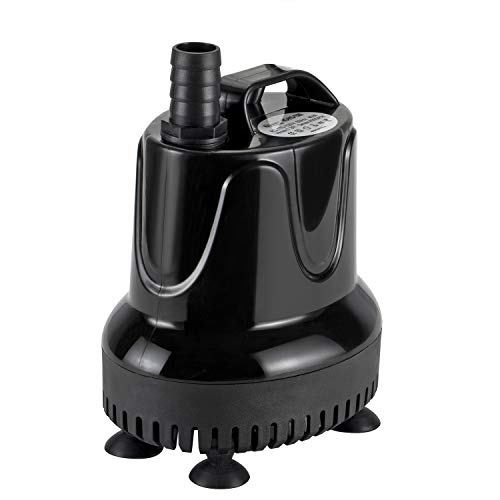
The hygger 400 GPH is the maintenance specialist in this guide, designed around the job of draining and refilling a tank rather than permanent circulation. Its bottom intake can pull the water level down to a quarter of an inch, which clears debris and fish waste from the tank floor during a water change instead of leaving a shallow layer behind. Three barb fittings in different sizes connect it to common hose diameters, and the oil-free magnetic motor is suited to both freshwater and saltwater use. With a 7.3-foot maximum lift, it can also push drained water up and out of the tank to a drain or bucket.
Specs
- Maximum flow rate: 400 GPH
- Wattage: 40W
- Maximum lift height: 7.3 feet
- Dimensions: 5 x 4 x 5.7 inches
- Power cord length: 6 feet
- Includes 3 barb fittings
- Drains water down to 1/4 inch
- Motor: Oil-free magnetic driven motor
Best for: Regular water changes and draining tanks down to a low level for cleaning.
Watch out for: Confirm the barb fitting sizes against your hose before ordering, since a loose hose connection can leak during a water change.
PULACO 400GPH Submersible Pump with 5 ft Tubing

The PULACO 400GPH is the most ready-to-run pump in this guide, because it arrives with 5 feet of tubing in the box. That spares a first-time buyer the separate trip for hose and means the pump can be installed as soon as it arrives, whether it is feeding a filter, a fountain, or a small pond feature. Its 400 GPH maximum flow suits medium tanks and features, and the adjustable flow valve lets you set the output to match the job. The compact body, at 3.3 x 2.3 x 2.8 inches, fits into tighter spaces than the larger pumps here, and the detachable design makes the impeller accessible for cleaning.
Specs
- Maximum flow rate: 400 GPH (1500 L/H)
- Wattage: 25W
- Maximum lift height: 6.6 feet
- Includes 5 ft tubing
- Power cord length: 6 feet
- Dimensions: 3.3 x 2.3 x 2.8 inches
- Detachable and cleanable design
- Adjustable flow valve
Best for: First-time buyers who want a pump with tubing included and a compact body for tight spaces.
Watch out for: Check the tubing diameter against your existing fittings, since the included tubing may not match every filter or fountain inlet.
Uniclife 80 GPH Submersible Water Pump

The Uniclife 80 GPH is the small-tank pump in this guide, built for tabletop aquariums, betta tanks, and gentle water features where a big pump would overwhelm the setup. Its 80 GPH maximum flow and 2.4-foot maximum lift are modest, but they suit shallow tanks and small fountains where a light current is exactly what is needed. At only 4 watts it draws very little electricity, and the adjustable flow control lets you soften the output further for delicate fish or slow-moving water. A ceramic impeller is listed for long, quiet operation, which matters in a pump that often sits in a living room or bedroom.
Specs
- Maximum flow rate: 80 GPH (300 L/H)
- Wattage: 4W
- Maximum lift height: 2.4 feet
- Adjustable flow control
- Ceramic impeller
- Model: UL80
Best for: Small and tabletop aquariums, betta tanks, and gentle fountains that need light flow.
Watch out for: Select the 80 GPH option when ordering, since this listing covers several flow variants and the higher options are different pumps for larger tanks.
Which One Fits Your Situation
You run a large tank or a tall fountain
Choose the VIVOSUN 800GPH. Its 800 GPH maximum flow and 10-foot maximum lift are the highest in this guide, so it keeps delivering useful flow where other pumps fade, such as a sump return or a fountain head several feet above the tank. The adjustable flow knob also lets you tame the output if the full flow proves too strong for the livestock.
You do frequent water changes
Choose the hygger 400 GPH Quick Water Change Pump. Its bottom intake drains the tank down to a quarter of an inch, clearing debris and waste from the floor instead of leaving a layer behind for a siphon to chase. The three barb fittings cover common hose sizes, and the 7.3-foot lift moves drained water up and out without a struggle.
You want a pump that works straight out of the box
Choose the PULACO 400GPH. It ships with 5 feet of tubing included, so there is no separate hose to buy and no guessing about diameter on the first install. The compact body fits tight filter compartments, the adjustable flow valve sets the output to the job, and the detachable design makes routine cleaning simple.
You keep a small or nano tank
Choose the Uniclife 80 GPH. Its 80 GPH flow and 2.4-foot lift are sized for tabletop and betta tanks, where larger pumps create a current that stresses fish and stirs the substrate. At 4 watts it costs little to run, and the adjustable flow control lets you soften the output even further for the most delicate setups.
Common Mistakes
- Buying on flow rate alone and ignoring lift height, so the pump delivers only a trickle once it has to push water uphill.
- Choosing a pump far too strong for the tank, creating a current that stresses fish and keeps substrate in constant motion.
- Forgetting to check outlet and hose sizes, then finding the pump will not connect to the existing filter or fountain.
- Installing the pump where the power cord cannot reach an outlet safely, leaving the cord stretched taut or draped across the tank.
- Skipping impeller cleaning until the pump grows noisy or weak, when regular cleaning would have kept it running well.
Frequently Asked Questions
What size aquarium water pump do I need?
Start with the job, not the number. For circulation or a filter loop, match the pump’s maximum flow to the tank volume, remembering that flow is a maximum at little or no lift. For a fountain or sump, measure the vertical lift and choose a pump whose lift clears it with room to spare. When in doubt, pick a pump with adjustable flow so you can turn the output down.
Can a submersible pump run dry?
No. Submersible aquarium pumps are cooled and lubricated by the water around them, so running one dry can overheat the motor and damage the impeller in a short time. Always keep the pump fully submerged while it is switched on, and switch it off before draining the tank below the pump body. If a pump must sit in very shallow water, choose a model built for low-level draining.
How often should I clean an aquarium water pump?
Clean the impeller and intake every few weeks in a tank, and more often if the tank is heavily stocked. Algae, grit, and debris build up on the impeller and in the intake grille, which reduces flow and makes the pump noisier over time. Unplug the pump, open the housing, rinse the parts in tank water, and check the impeller spins freely before reassembling.
Can I use the same pump for freshwater and saltwater?
Many submersible pumps are built for both, but check the listing before ordering, since seals and impeller materials vary by model. Saltwater is harder on metal parts, so a pump with plastic housing and a ceramic or magnetic impeller usually holds up better. Rinse the pump in fresh water after saltwater use and clean it regularly to slow corrosion.