Key takeaways
- Compare five aquarium air pumps for freshwater tanks, from nano setups to large systems. Quiet airflow, dual outlets, and adjustable output explained.
A freshwater tank without enough dissolved oxygen turns sluggish fast. Fish hover near the surface, beneficial bacteria slow down, and a sponge filter driven by weak airflow barely moves water through its media. The real decision is not which pump is loudest or strongest, but which one delivers steady, adjustable airflow at a volume your tank actually needs, without humming through the wall at night.
This guide is for freshwater keepers setting up a first tank, running sponge filters in a breeding rack, or replacing a pump that has grown noisy with age. Every pump below was chosen from its Amazon listing name and listed specifications, so you can match tank size, outlet count, and airflow control to your own setup before you buy.
Quick Picks
As an Amazon Associate we earn from qualifying purchases.
| Product | Best for | Key spec from title |
|---|---|---|
| Tetra Whisper Air Pump, Up to 10 Gallons | Nano tanks and betta setups | For aquariums up to 10 gallons |
| Tetra Whisper Air Pump, 40 to 60 Gallons | Mid-size community tanks | For aquariums from 40 to 60 gallons |
| Uniclife UL40 Aquarium Air Pump | Dual-outlet sponge filter setups | 64 GPH, dual outlets, for 10-100 gallon tanks |
| hygger HG219 Aquarium Air Pump | Adjustable airflow with stainless outlets | Dual stainless steel outlets, 4W/7W/11W options |
| Pawfly 50 GPH Aquarium Air Pump | A complete kit for a first tank | 50 GPH, dual outlet, for 10-60 gallon tanks |
How to Choose
Match Airflow to Tank Size, Not to the Loudest Pump
A pump sized for a tank far larger than yours wastes energy and pushes bubbles hard enough to stress small fish and stir up substrate. An undersized pump leaves a sponge filter underpowered and oxygen levels thin at the bottom of a tall tank. Check the tank-size range printed on the listing first, then pick a pump whose range covers your tank near its middle rather than at its edge. A 20-gallon tank runs best on a pump sized for roughly 10 to 40 gallons, because that leaves room to turn the flow down for a betta or up for a heavily stocked community.
Count Outlets Before You Count Gadgets
One outlet feeds one air stone or one sponge filter. Two outlets let you run a sponge filter and a decorative bubbler, or split air between two small tanks from a single pump. If you plan to run more than one device, a dual-outlet pump with a control knob saves you from buying a gang valve and a second pump later. For a fish room with a rack of breeding tanks, a single higher-output pump feeding a manifold makes more sense than a row of small pumps, but for one or two tanks, two outlets cover almost every freshwater setup.
Treat Noise Figures as a Starting Point
Manufacturers quote decibel numbers measured in ideal conditions, so a pump listed under 35 dB can still buzz if it sits on a hard shelf or against a glass panel. The shape of the housing, rubber feet, and the way the diaphragm is mounted matter as much as the number. Place the pump on a soft mat or hang it, keep airline tubing short and free of kinks, and remember that a pump that sounds silent in a shop can still transmit vibration through a wooden stand at night.
Check What Comes in the Box
Some air pumps ship as a bare unit, while others include airline tubing, air stones, check valves, and connectors. A check valve matters more than it looks: it stops tank water from siphoning back into the pump during a power cut, which can ruin the motor. If the listing does not include one, add it to your order. A kit that includes tubing and stones gets a new tank running the same day, while a bare pump can leave you waiting on a second delivery.
The 5 Best Options
Tetra Whisper Air Pump, Up to 10 Gallons
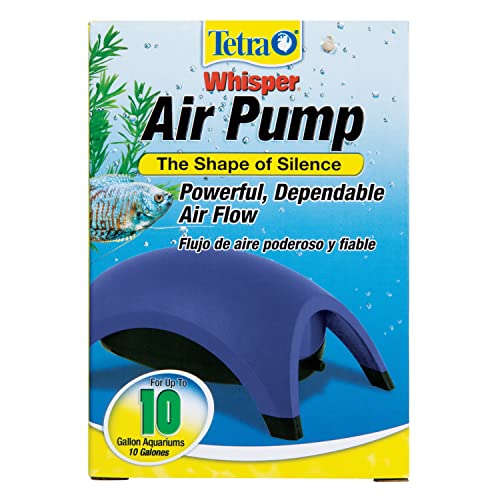
Small tanks need gentle airflow, and this is the pump Tetra builds for exactly that job. It suits nano aquariums, betta tanks, and shrimp setups where a strong current would push livestock around the tank. Its dome-shaped housing sits neatly beside a small tank, and the single outlet feeds one air stone or one small sponge filter without overwhelming the water. For a desktop aquarium or a quarantine tank, it is the simplest fit in this guide.
Specs
- For aquariums up to 10 gallons
- Single outlet for one air stone or sponge filter
- Dome-shaped housing designed for quiet operation
- Model number 77851
Best for: Nano tanks, betta tanks, and shrimp setups that need gentle airflow.
Watch out for: The single outlet feeds only one device, so a second air stone or filter needs a splitter or a second pump.
Tetra Whisper Air Pump, 40 to 60 Gallons

When the tank grows past 30 gallons, a small pump stops keeping up, and this larger Whisper model is built for that middle range. It suits community tanks with tetras, guppies, and corydoras, where steady surface agitation keeps oxygen levels stable through the night. The higher output drives a full-size sponge filter or a long air stone bar across a four-foot tank, and the familiar dome design keeps the unit stable on a shelf beside the stand.
Specs
- For aquariums from 40 to 60 gallons
- Single outlet with strong, steady airflow
- Dome-shaped housing designed for quiet operation
- Model number 77854
Best for: Mid-size community tanks that need more airflow than a nano pump can deliver.
Watch out for: On a tank at the small end of its range, the full output may be too strong for slow-moving fish unless you add a control valve to the airline.
Uniclife UL40 Aquarium Air Pump
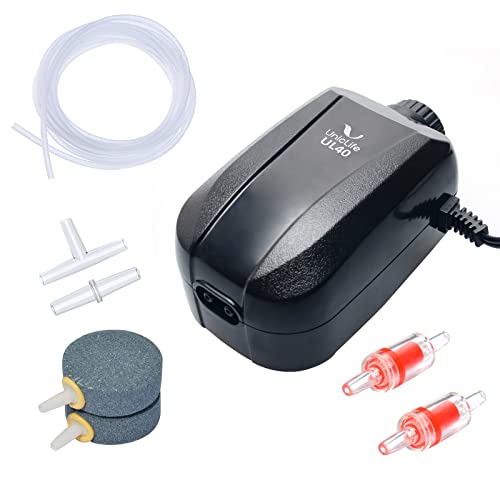
The UL40 is the workhorse of this list, a dual-outlet pump that has become a default choice for sponge-filter setups. Two outlets let you run two filters, or one filter and one air stone, from a single unit, and the rotary knob adjusts the flow to both. Its 64 GPH maximum flow covers tanks from 10 to 100 gallons, which makes it a flexible pick for keepers who plan to upgrade tank sizes later. The listed noise figures run from 25 dB on the low setting to 45 dB at full flow, roughly the hum of a refrigerator.
Specs
- Maximum flow of 64 GPH
- 4 watts power draw
- Dual outlets with a rotary airflow knob
- For tanks from 10 to 100 gallons
- Listed noise from 25 dB at low flow to 45 dB at full flow
- Pressure of 0.016 MPa
- Includes air stone, airline tubing, check valve, and connector accessories
Best for: Keepers running sponge filters who want two outlets and adjustable flow in one pump.
Watch out for: Both outlets share one control knob, so you cannot set a different flow rate for each outlet without adding separate valves.
hygger HG219 Aquarium Air Pump

The HG219 stands out in this list for its dual stainless steel outlets and its adjustable output across three power options. It suits planted tanks and larger community setups where you want to fine-tune bubble size and flow through the day. The stainless outlets resist corrosion better than plastic barbs in a damp cabinet, and the included air stone produces fine bubbles that rise slowly through the water column. With 4W, 7W, and 11W versions in the same listing family, you can size the pump to the tank instead of forcing one output level to fit every setup.
Specs
- Dual stainless steel air outlets
- Adjustable airflow control
- Available in 4W, 7W, and 11W versions
- Includes air stone bubbler accessories
- For small, medium, and large fish tanks
Best for: Planted tanks and community setups where adjustable airflow and durable outlets matter.
Watch out for: Confirm which wattage version you are ordering, because the listing covers three power options and the output differs between them.
Pawfly 50 GPH Aquarium Air Pump

Pawfly packs this pump as a complete kit, which makes it a strong pick for a first freshwater tank. The box includes airline tubing, air stones, connectors, check valves, and a nano bio sponge filter, so the pump can run a filter the day it arrives. Its 50 GPH output and dual adjustable outlets cover tanks from 10 to 60 gallons, a range that fits the most common home aquariums. The adjustable control lets you dial the flow down for a tank with a betta or up for a stocked community tank.
Specs
- Maximum flow of 50 GPH
- Dual outlets with adjustable airflow
- For fish tanks from 10 to 60 gallons
- Includes airline tubing, air stones, connectors, check valves, and a nano bio sponge filter
Best for: First-time keepers who want a pump and a sponge filter in one box.
Watch out for: The included sponge filter suits a single tank, so a second tank still needs its own filter even though the pump has two outlets.
Which One Fits Your Situation
A Nano Tank on a Desk
A tank under 10 gallons needs gentle bubbles and a pump that will not dominate the desk. The Tetra Whisper for up to 10 gallons fits here, with a single outlet and a compact dome housing. Pair it with a small air stone and keep the tubing short so the pump sits close to the tank.
A Community Tank With a Sponge Filter
If your filter runs on air, the pump is part of the filtration system, not an accessory. The Uniclife UL40 fits here, because its dual outlets and 64 GPH output drive a sponge filter with room to spare, and the rotary knob lets you tune the flow to the stocking level. The Tetra Whisper 40 to 60 gallon model is the alternative when you want a single-outlet pump with a long track record.
A Planted Tank Where Flow Needs Tuning
Planted tanks change through the day as plants take up carbon dioxide and release oxygen, so fixed airflow is a compromise. The hygger HG219 fits here, with adjustable airflow and stainless outlets that hold up in a humid cabinet. Start low in the morning and raise the flow if fish gather near the surface in the evening.
A First Tank With Nothing Bought Yet
Buying a pump, tubing, stones, valves, and a filter separately adds up to several orders. The Pawfly 50 GPH kit fits here, because one box covers the pump and the sponge filter together for a 10 to 60 gallon tank. Check that the included check valve is fitted before the first fill, and keep the spare outlet capped until you need it.
Common Mistakes
- Buying a pump sized far above the tank size, then fighting excess current that stresses fish and uproots plants.
- Placing the pump below the waterline without a check valve, so tank water siphons back into the motor during a power cut.
- Running long, kinked airline tubing that chokes airflow and makes the pump work harder and louder.
- Skipping the control valve on a single-outlet pump, leaving no way to turn the flow down for slow-moving fish.
- Judging noise in the shop instead of on the stand at home, where vibration through wood or glass makes the same pump sound louder.
Frequently Asked Questions
How much airflow does a freshwater tank need?
There is no single number, because stocking level, temperature, and plant load all change oxygen demand. As a starting point, pick a pump whose listed tank range covers your tank near its middle, then watch the fish. If they gather at the surface in the morning, raise the flow or add surface agitation.
Do air pumps replace a filter?
No. An air pump moves air, and a sponge filter or undergravel filter uses that air to move water through its media. The pump alone does not remove waste. In a tank with a hang-on-back or canister filter, an air pump adds oxygen and surface movement but does not take over filtration.
Where should I place an air pump?
Above the waterline is safest, because it stops water from siphoning back into the unit. If the pump must sit below the tank rim, fit a check valve in the airline close to the tank. Set the pump on a soft surface or hang it so vibration does not travel through the stand.
Why is my air pump getting louder over time?
Diaphragms wear, tubing hardens, and air stones clog with mineral deposits. Clean or replace the air stone first, check the tubing for kinks, and move the pump onto a soft mat. If the hum stays loud after those steps, the diaphragm inside the pump is likely worn and the unit is near the end of its service life.