Key takeaways
- Two whole-house booster pumps compared for steadier water pressure, covering a quiet integrated Grundfos unit and an adjustable Aquastrong model.
Weak pressure rarely fails all at once. It shows up when a shower fades because the washing machine kicked on, or when an upstairs tap slows to a trickle while someone fills a tub downstairs. The real decision is not simply adding a pump; it is choosing a booster that holds pressure steady through those overlapping demands, fits the pipework you already have, and can draw reliably from your incoming supply without running dry or cycling noisily all day.
Two buyer groups dominate this purchase: households on low municipal pressure who want one quiet, set-and-forget unit, and households that need to dial in a specific pressure target for a larger plumbing layout. Both picks here are fully integrated, variable-speed booster pumps chosen from their Amazon listing names and specifications: the Grundfos SCALA2 3-45 in its 115V form, and the Aquastrong Smart 45, which exposes its pressure setting as an adjustable range rather than a single fixed point.
Quick Picks
As an Amazon Associate we earn from qualifying purchases.
| Product | Best for | Key spec from title |
|---|---|---|
| Grundfos SCALA2 3-45, 115V | Quiet all-in-one boosting near living space | Integrated variable-speed unit with 1″ NPT connections |
| Aquastrong Smart 45 | Homes that want an adjustable pressure target | Pressure setting range of 22–80 PSI, preset at 44 PSI |
How to Choose
Constant Pressure Versus Fixed-Speed Cycling
Older booster setups pair a fixed-speed pump with a pressure tank and a switch, so pressure swings between the cut-in and cut-out points and the pump lurches on and off. A variable-speed drive instead slows or speeds the motor to hold one steady pressure, which is why both pumps in this article are integrated variable-speed designs. If your complaint is a shower that pulses or fades, constant pressure matters more than raw power. If your pressure is simply low but stable, either design works, though the variable-speed units here also remove the separate tank, switch and control box from the shopping list.
Flow and Head Matched to Your Home
Two numbers decide whether a booster actually fixes your problem. Flow, stated in gallons per minute or per hour, must cover your simultaneous fixtures: a shower, a toilet refill and a kitchen tap can overlap easily in a family home. Head, stated in feet, is the lifting and pushing power behind that flow, and it shrinks as flow rises. Compare the rated flow figure, not only the maximum, because the maximum is measured under ideal conditions. A two-storey house with a bathroom above the pump needs more head in reserve than a single-level home of the same size.
Suction Conditions and Self-Priming
A booster can only push what it can draw. Check where your water comes from: a pressurised municipal line is the easy case, while a cistern, tank or shallow source asks the pump to lift water before boosting it. Self-priming designs, like both units here, can evacuate air from the suction line and recover after interruptions, which saves manual priming after maintenance or a supply outage. Note the maximum suction lift in the specifications and measure your own lift honestly, including horizontal runs. Dry-run protection is the related safeguard, cutting the motor before a starved pump damages itself.
Noise, Footprint and Connections
Booster pumps often live in utility cupboards, garages or basements close to bedrooms, so operating noise deserves the same attention as performance. A stated figure around 47 dB(A) in typical use, as the Grundfos listing gives, is roughly conversation level and unlikely to disturb sleep through a closed door. Footprint matters too: an integrated unit with its tank and controls inside one housing needs far less wall and floor space than a pump-plus-tank assembly. Finally, confirm the connection size against your pipework before ordering; both pumps here use straightforward fittings, but adapters add cost, joints and potential leak points.
The 2 Best Options
Grundfos SCALA2 3-45, 115V
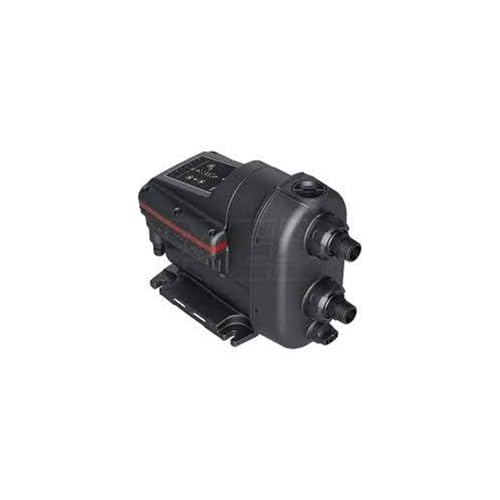
The SCALA2 is the pick for buyers who want the whole boosting system engineered as one appliance. Grundfos builds the pump, variable-speed drive, tank, sensors and non-return valves into a single compact housing, so there is no separate pressure tank to size and no external controller to wire. It self-primes, which suits homes drawing from a tank or cistern as well as pressurised lines, and its stated noise level in typical use is low enough for a utility room beside living space. For a household whose pressure sags whenever fixtures overlap, this is the calmest, simplest route to steady taps.
Specs
- Model: SCALA2 3-45, model number 98562818
- Design: fully integrated booster with pump, variable-speed drive, tank, sensors and non-return valves in one unit
- Voltage: 115V
- Rated flow: 13.2 GPM
- Maximum flow: 60 L/min
- Maximum head: 147 ft
- Maximum suction lift: 8 m
- Connections: 1″ NPT inlet and outlet
- Noise: 47 dB(A) in typical use
- Weight: approximately 22 lb
- Priming: self-priming
Best for: Homes on weak municipal pressure or a tank feed that want quiet, steady pressure from one compact unit with nothing extra to install.
Watch out for: Confirm the listing in front of you is the 115V version of the SCALA2 3-45 (model 98562818) before ordering, because other SCALA2 variants and a newer generation circulate through different channels and their figures do not transfer to this listing.
Aquastrong Smart 45 (WHBP-45)

The Smart 45 suits buyers who want to set the target pressure themselves rather than accept a factory behaviour. Its listing gives a pressure setting range of 22–80 PSI with a 44 PSI preset, so a plumber can raise the set point for a tall house or lower it for older pipework that should not be pushed hard. Like the Grundfos, it is a fully integrated variable-speed constant-pressure booster and it self-primes, with dry-run protection listed among its features. The headline flow and head figures are generous for the class, which makes it the more configurable of the two picks here.
Specs
- Model: Smart 45, model number WHBP-45
- Design: fully integrated variable-speed constant-pressure booster
- Voltage: 115V
- Maximum flow: 1500 GPH
- Maximum head: 150 ft
- Pressure setting range: 22–80 PSI, preset at 44 PSI
- Power: 560 W per the Amazon product details
- Priming: self-priming
- Protection: dry-run protection
Best for: Larger or taller homes where the installer wants to tune the delivery pressure to the plumbing instead of accepting a preset.
Watch out for: Confirm a live featured offer for this exact ASIN, B0DZCSCRXS, before ordering, and while you are on the page check the wattage in the product details block, because secondary coverage of this model quotes different power figures than the listing itself.
Which One Fits Your Situation
Your Shower Fades When Other Fixtures Run
That pulsing, fading pattern is exactly what constant-pressure control is built to remove, and both pumps here use variable-speed drives. Choose the Grundfos SCALA2 if the pump will sit near bedrooms or living space, because its stated 47 dB(A) typical noise and single-housing design make it the quieter, tidier install. Either unit will smooth the overlap between a shower and a washing machine; the Grundfos simply does it with less fuss around it.
You Draw Water From a Tank or Cistern
Suction behaviour decides this one. Both picks self-prime, but the SCALA2 states a maximum suction lift of 8 m and integrates its non-return valves, which simplifies a tank-fed layout and helps the system recover after the tank is drained for cleaning. Measure your actual lift from water level to pump before committing, and keep suction pipework short and airtight, because no booster performs well while drawing air through a leaking joint.
Your House Is Tall or Your Pipework Is Old
A two- or three-storey home needs pressure held at height, while older pipes argue for restraint. The Aquastrong Smart 45 fits both worries because its set point adjusts across a 22–80 PSI range: start near the 44 PSI preset, then raise it only until the top-floor shower satisfies you. That adjustability is the reason to pick it over the Grundfos here, provided you confirm the live offer for its ASIN first.
You Have Very Little Space for Equipment
Pick the SCALA2. Its tank, drive, sensors and valves share one housing of roughly 22 lb, so it mounts where a separate pump, tank and control box never would: a utility cupboard, under-stair void or garage corner. The Aquastrong is also integrated, but the Grundfos package is the more compact proposition on the figures its listing states, and its 1″ NPT connections keep the plumbing adaptation simple for a standard residential line.
Common Mistakes
- Sizing by maximum flow alone: the maximum is an ideal-condition figure, so a pump chosen on that number can still disappoint at real simultaneous demand; compare the rated flow and keep head in reserve for upper floors.
- Ignoring the suction side: buyers measure the pressure they want but never the lift the pump must draw against, then blame the booster when a long or leaky suction line starves it of water.
- Cranking the set point to maximum: on an adjustable unit like the Smart 45, the highest setting stresses old joints, hoses and appliance valves; raise pressure gradually and stop at the lowest setting that fixes the complaint.
- Buying the wrong variant: similar model names cover different voltages and generations, so ordering without checking the exact model number and voltage on the listing can leave you with a unit your supply cannot run.
- Skipping dry-run protection: a booster that keeps spinning against an empty tank or closed supply overheats quickly, yet buyers often treat protection features as marketing filler instead of the safeguard that saves the motor.
Frequently Asked Questions
Will a booster pump fix low pressure throughout the whole house?
Usually, yes, provided the incoming supply delivers enough volume. A booster raises pressure; it cannot create water that the line or tank does not supply. Both pumps here are whole-house designs with integrated controls, so placed on the main feed after any filtration they lift pressure at every fixture, with the strongest improvement felt at showers and upper-floor taps.
What is the difference between rated flow and maximum flow?
Maximum flow is measured with minimal resistance, while rated flow is the figure the manufacturer stands behind under working conditions. The SCALA2, for example, lists a rated flow of 13.2 GPM alongside a 60 L/min maximum. Size your purchase around the rated figure and your household’s simultaneous demand, and treat the maximum as headroom rather than a promise.
Can I install one of these pumps myself?
A competent DIYer with plumbing experience can fit an integrated booster, since the tank, drive and controls are already inside the housing and connections are standard threaded fittings. You still need a suitable electrical supply, a shut-off and drain point, and local code compliance. If the pump feeds from a tank or your pipework is old, a plumber’s hour is cheap insurance.
How loud is a booster pump in normal use?
It depends on the design and where it sits. The Grundfos listing states 47 dB(A) in typical use for the SCALA2, close to quiet conversation, and variable-speed drives generally run softer than fixed-speed pumps because they rarely spin at full speed. Mounting on a solid base away from bedroom walls keeps transmitted vibration down further.