Key takeaways
- Find the best rv water pumps for your rig: five 12V picks compared on flow, pressure, noise and priming, with sizing and install tips for steady water.
The freshwater pump is the heartbeat of an RV plumbing system. Every shower, faucet flush and kettle fill away from a city water hookup depends on a 12V diaphragm pump pulling water from the tank and holding pressure steady across the lines. When a pump ages out, the signs are hard to miss: pulsing flow, a motor that cycles every few seconds, weak pressure at the shower head, or a grinding noise from the utility bay at two in the morning. Replacing it with the right model restores calm, even water delivery and removes one of the most common sources of leaks and battery drain on the road.
This guide compares five 12V RV freshwater pumps, each chosen for a different priority. One is the balanced all-rounder most owners should buy first. The others lead on flow rate, quiet running, priming and dry-run tolerance, or value. Every pick below is a pressure-demand diaphragm pump sized for RV fresh water systems, and the specs quoted come from maker listings and technical data sheets so you can match a pump to your rig with confidence.
As an Amazon Associate, we earn from qualifying purchases.
Quick answer
The SHURFLO Revolution 4008-101-E65 is the best overall RV water pump for most rigs: 3.0 GPM at 55 PSI, an internal bypass for smooth delivery, and a footprint that drops into the space left by older factory pumps. High-demand coaches should look at the SEAFLO 55-Series, light sleepers at the variable-speed Remco Aquajet, and budget repairs at the SEAFLO 33-Series.
SHURFLO Revolution 4008-101-E65: Best overall

The Revolution 4008 is the pump that countless RVs already carry from the factory, and that installed base is itself a recommendation. Its 3.0 GPM flow and 55 PSI shut-off pressure cover the needs of a typical travel trailer or motorhome with one bathroom, a galley sink and an outdoor shower. A single fixture runs at full, even pressure, and two modest fixtures can share the flow without the shower collapsing to a trickle.
What sets the Revolution apart from older designs is the internal bypass and one-piece diaphragm. The bypass recirculates a portion of the flow inside the pump head, which softens the on-off cycling that makes lesser pumps pulse and hammer. Delivery feels closer to a home tap: pressure builds smoothly, the pump stops cleanly when the faucet closes, and it does not chatter against a nearly closed valve. The pump self-primes, tolerates brief dry running, and carries thermal protection on the motor.
Practical details suit it to retrofit work. The ports are the common half-inch size used across the industry, mounting feet are rubber isolated, and the unit is compact enough for the tight bays where RV pumps usually live. Because so many rigs shipped with this exact model family, replacement is often a wire-for-wire, hose-for-hose swap measured in minutes.
- Voltage: 12V DC
- Flow rate: 3.0 GPM
- Shut-off pressure: 55 PSI
- Design: diaphragm pump with internal bypass
- Self-priming: yes, with dry-run tolerance
- Ports: 1/2 inch NPSM
- Protection: thermal overload with automatic reset
SEAFLO 55-Series Diaphragm Pump: Highest flow rate

Large coaches with two bathrooms, a washing machine or long pipe runs ask more of a pump than the standard 3.0 GPM class can give. The SEAFLO 55-Series answers with 5.5 GPM of open flow at a 60 PSI shut-off, the strongest delivery in this roundup. A five-chamber diaphragm moves that volume with less pulsation than a smaller pump working at its limit, so a shower and a sink can run together without either one fading.
An internal bypass valve reduces cycling at low demand, which protects the heavy-duty pressure switch and keeps delivery composed when only a trickle is needed. The pump self-primes and is built for continuous multi-fixture service in RVs, boats and off-grid cabins. SEAFLO backs the 55-Series with a four-year warranty, a meaningful signal for a pump expected to work hard.
Flow this strong comes with homework. The motor draws considerably more current than a 3.0 GPM pump, so the supply wiring and fuse need to match the rating on the label, and older plumbing should be checked fitting by fitting before it sees 60 PSI. Owners of big rigs who make those checks get the closest thing to household water pressure that a 12V system can offer.
- Voltage: 12V DC
- Flow rate: 5.5 GPM
- Shut-off pressure: 60 PSI
- Design: five-chamber diaphragm with internal bypass
- Self-priming: yes
- Switch: heavy-duty pressure switch
- Warranty: four years
Remco Aquajet ARV: Quietest

Most RV pump noise is not the motor itself but the cycling: a fixed-speed pump slamming on and off against demand. The Remco Aquajet ARV attacks the problem with variable-speed control. Its electronics read demand and adjust motor speed to match, so a cracked-open faucet gets a slow, gentle turn of the pump instead of a full-power burst. The result is a pump that murmurs where conventional units buzz, and pressure that stays remarkably even at every tap.
The five-chamber design supports that smoothness with up to 5.3 GPM of open flow and a 65 PSI pressure setting, so quiet does not mean weak. A soft, ramped spin-up removes the thump that travels through rigid plumbing at night, and the controller includes low-voltage protection plus a maximum-pressure bypass to guard the coach plumbing. Quick-attach three-quarter-inch ports suit the larger lines found in bigger motorhomes.
The Aquajet is the premium route to a quiet rig, and it asks for a clean install: follow the maker guidance on accumulator tanks, since variable-speed pumps manage pressure electronically rather than by tank volume. For full-timers and light sleepers, the calm is worth the planning.
- Voltage: 12V DC
- Flow rate: up to 5.3 GPM open flow
- Pressure setting: 65 PSI
- Design: five-chamber diaphragm, variable speed
- Ports: 3/4 inch quick attach
- Protections: low-voltage cut-off, maximum-pressure bypass
- Self-priming: yes
SHURFLO 4048-153-E75 High Flow: Best self-priming and dry-run tolerant
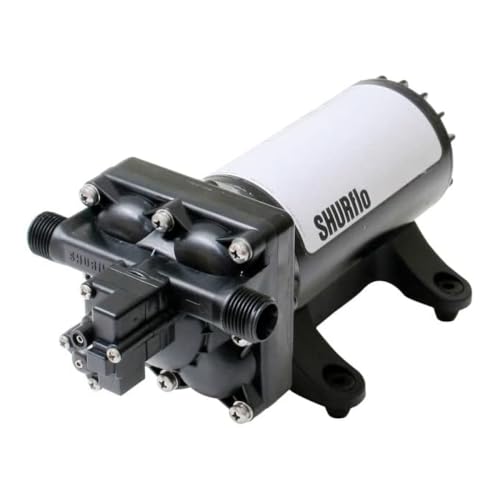
Boondockers who refill from portable containers, and owners whose tanks regularly run low, need a pump that forgives abuse. The SHURFLO 4048-153-E75 is rated to dry-prime up to six feet and to run dry without damage, per its maker technical data sheet. If the tank empties mid-shower, the pump survives the event; when water returns, it pulls its prime again instead of sitting air-locked until someone crawls into the bay to sort it out.
Beyond resilience, the 4048 is a strong performer in its own right. A four-chamber diaphragm delivers 4.0 GPM at a 55 PSI shut-off, enough for two fixtures at once, and flow-reaction technology with an internal bypass keeps delivery smooth. Thermal overload protection with automatic reset guards the motor, and an integrated check valve prevents backflow toward the tank. The box includes a 50-mesh inlet strainer and hose barb fittings, small inclusions that matter because grit is the natural enemy of diaphragm valves.
Note the electrical appetite before ordering: this is a 10-amp class pump, and the maker recommends a 15-amp fuse with wiring sized to suit. Rigs with long, thin factory wire runs should budget for a cable upgrade so the pump sees full voltage under load.
- Voltage: 12V DC
- Flow rate: 4.0 GPM
- Shut-off pressure: 55 PSI
- Dry-prime lift: up to 6 feet
- Run dry: yes, rated for dry running
- Max current draw: 10 amps, 15-amp fuse recommended
- Included: inlet strainer and barb fittings, integrated check valve
SEAFLO 33-Series Diaphragm Pump: Best budget

Not every pump replacement needs to be an upgrade. For a spare, a small trailer, or a repair bill that has to stay lean, the SEAFLO 33-Series covers the fundamentals honestly. It delivers 3.0 GPM at 45 PSI from a three-chamber diaphragm, runs on demand through a built-in pressure switch, and self-primes with a lift of up to six feet. SEAFLO also rates the 33-Series to run dry, a forgiving trait at any price point.
The softer 45 PSI ceiling is a fair trade in context. Smaller rigs with short pipe runs rarely need more, and gentler pressure is kinder to older fittings and push-connect plumbing. The pump ships with fittings and an inlet filter in most listings, mounts with the same half-inch port pattern used across the industry, and carries a four-year warranty that budget pumps rarely offer.
Where the savings show up is refinement. Expect more audible cycling than the bypass-equipped pumps above, and plan on an accumulator tank if faucet pulsing bothers you. As a dependable, low-cost route back to full water service, it earns its place.
- Voltage: 12V DC
- Flow rate: 3.0 GPM
- Shut-off pressure: 45 PSI
- Design: three-chamber diaphragm, built-in pressure switch
- Self-priming: up to 6 feet, run-dry capable
- Ports: 1/2 inch MNPT
- Warranty: four years
How to choose
Match flow to fixtures first. A single-bathroom rig lives happily on 3.0 GPM; two bathrooms, a washer or an outdoor kitchen point toward 4.0 GPM and above. Pressure comes second: 45 to 55 PSI suits most factory plumbing, while 60 PSI and higher demand a careful check of fittings, hoses and the water heater relief valve before installation.
Then consider how the pump manages demand. Internal bypass designs soften cycling and extend switch life. Variable-speed pumps go further, matching output to demand electronically for the quietest, steadiest delivery. If noise matters, also plan the install itself: flexible hose loops on both ports, rubber mounting feet on a solid surface, and no rigid pipe hard-mounted to the pump head.
Priming and protection decide how forgiving the pump will be. Look for a stated self-priming lift, dry-run tolerance, thermal protection and an inlet strainer. Finally, check the electrical side: confirm the amp draw, fuse the circuit to the maker recommendation, and use wire thick enough that voltage at the pump stays close to battery voltage under load. Undersized wire is the hidden cause behind many weak-pump complaints.
Who should skip
Owners whose rigs are still under a factory plumbing warranty should confirm that a non-original pump will not complicate a claim before swapping. Anyone with a 24V electrical system should skip this entire list, since every pick here is a 12V unit. If your water problem is low pressure only at one faucet, the fault is more likely a clogged aerator, a kinked line or a failing inlet strainer than the pump itself, and replacing the pump will not fix it.
These are freshwater supply pumps only. They are not macerator pumps, not transfer pumps for fuel or chemicals, and not rated for continuous duty as a home pressure system. Households that mostly camp with full hookups and rarely draw from the tank can also defer the upgrade: a healthy factory pump plus a small accumulator tank solves most pulsing complaints for less effort.
Frequently Asked Questions
How long should an RV water pump last?
Service life depends on use, water quality and how often the pump runs dry or against a blocked line. A quality diaphragm pump in a weekend-use rig commonly serves for many seasons, while full-time use shortens that span. Keeping the inlet strainer clean and fixing small leaks promptly, so the pump does not cycle against a pressure loss all night, are the simplest ways to extend its life.
Can I install a higher-flow pump than the one my RV came with?
Usually yes, provided three things check out: the wiring and fuse can carry the higher amp draw, the plumbing and fittings are sound enough for the pressure setting, and the physical space fits the larger body. Stepping from 3.0 to 4.0 or 5.5 GPM is a popular upgrade in larger coaches, but tired push-connect fittings should be renewed first.
Why does my new pump keep cycling on and off?
Short cycling usually means the pump is building pressure faster than the open fixture can release it, or that a small leak somewhere is bleeding pressure down until the switch calls for more. Check for drips at fittings, the toilet valve and the water heater drain, clean the inlet strainer, and consider an accumulator tank, which gives the system a cushion of volume and calms the switch.
Do I need an accumulator tank with these pumps?
Not strictly, but many owners appreciate one. A small tank smooths faucet delivery, reduces night-time pump runs to brief, widely spaced top-ups, and softens the hammer effect in the lines. Variable-speed pumps such as the Aquajet manage pressure electronically and their makers generally advise against pairing them with a tank, so follow the guidance for the specific model you choose.
Final verdict
For most owners, the SHURFLO Revolution 4008-101-E65 remains the sensible default: proven, smooth and sized for the average rig. Step up to the SEAFLO 55-Series when several fixtures run at once in a large coach, or to the Remco Aquajet when quiet nights matter more than anything. The SHURFLO 4048-153-E75 suits dry campers who need priming strength and dry-run forgiveness, and the SEAFLO 33-Series keeps smaller rigs in service at the friendliest cost. Choose by flow, pressure and wiring readiness, and any of the five will return steady water to the taps.
Product and ASIN Reference
| Product | ASIN |
|---|---|
| SHURFLO Revolution 4008-101-E65 | B002XM5G70 |
| SEAFLO 55-Series Diaphragm Pump | B07QLJ3WHP |
| Remco Aquajet ARV (55-AQUAJET-ARV) | B004RCSLFS |
| SHURFLO 4048-153-E75 High Flow | B007RYMT7O |
| SEAFLO 33-Series Diaphragm Pump | B00P8BE6S8 |