Key takeaways
- Compare 4 water pressure pumps for homes, RVs, and gardens. Flow, pressure, voltage, and fittings from Amazon listings to fix weak showers and taps.
Choosing a water pressure pump is a decision about how many taps can run at once, not about the biggest number on the box. A pump that adds plenty of pressure but moves too little water still leaves the upstairs shower weak when the washing machine fills, while an oversized pump can push a small plumbing system past what its fittings were made to hold. The right choice starts with your incoming supply: how much pressure you already have, how many fixtures run together, and where the pump will sit in the line.
This guide is for homeowners on weak city water, renters in upper-floor flats, RV and cabin owners, and gardeners feeding sprinklers from a hose. Each pump below was picked from its Amazon listing, with flow, pressure, voltage, and fittings taken from the product page, so you can match the numbers to your own plumbing before you buy.
Quick Picks
As an Amazon Associate we earn from qualifying purchases.
| Product | Best for | Key spec from title |
|---|---|---|
| Simer 4075SS-01 3/4 HP Pressure Booster Pump | Whole-house boost on city water | 3/4 HP, adds up to 40 PSI |
| TDRSUPER Water Pressure Booster Pump, 110V AC, 5.5GPM 75PSI | One weak shower or tap | 5.5 GPM, 75 PSI |
| ECO-WORTHY 33-Series Industrial Water Pressure Pump, 110V AC, 4.0GPM 50PSI | Garden hose and sprinkler boosting | 4.0 GPM, 50 PSI |
| SEAFLO 33-Series Water Pressure Pump, 115V AC, 3.3 GPM, 45 PSI | RV and small freshwater systems | 3.3 GPM, 45 PSI |
How to Choose
Match flow to how many fixtures run together
Flow, measured in gallons per minute, decides whether pressure holds when a second tap opens. A single shower or kitchen tap needs only a few gallons per minute, while a household where a shower, a dishwasher, and a garden hose run at once needs far more. Add up the fixtures you realistically use at the same time, then pick a pump whose listed flow covers that total with room to spare. A pump rated below your combined demand will feel strong at one tap and weak everywhere else, no matter how high its pressure figure looks.
Compare added pressure against what your pipes can take
Booster pumps add pressure on top of what already arrives at your home, so the headline number is only half the story. Measure or ask your supplier for your incoming pressure first, then add the pump’s stated boost to see the total your pipes and fixtures will carry. Older pipes, flexible hoses, and appliance inlet valves all have limits, and a pump that overshoots them can cause leaks at joints rather than better showers. Pick a boost that lifts weak fixtures into a comfortable range without pushing the whole system near its ceiling.
Look for automatic controls and dry-run protection
A good booster should start when a tap opens and stop when it closes, without you touching a switch. Automatic start and stop keeps the pump from running all day and spares the motor needless wear. Dry-run and overload protection matter just as much: if the supply is interrupted, a pump without protection can overheat while it keeps trying to draw water that is not there. Check the listing for a pressure switch, automatic operation, and some form of overload or overheat protection before you decide.
Check voltage, fittings, and where the pump will live
Most household boosters in this guide run on 110 or 115 volts from a standard wall outlet, but you still need to confirm the voltage and the plug type match your supply. Fitting size matters too: a pump with half-inch ports needs adapters to join a larger main line, and every adapter is a potential leak point. Think about placement as well, since inline whole-house pumps sit in the main supply line and usually need pipework changes, while compact diaphragm pumps can sit near a single fixture or a hose connection.
The 4 Best Options
Simer 4075SS-01 3/4 HP Pressure Booster Pump

The Simer 4075SS-01 is the pick for a whole house on city water that is simply a little weak. Its stainless steel body and automatic activation suit a permanent spot in the supply line, switching on when demand rises and off when taps close. With a well-known pump brand behind it and a straightforward fixed-speed design, it fits buyers who want steady extra pressure across the house rather than app controls or variable-speed settings.
Specs
- 3/4 HP motor
- Adds up to 40 PSI of extra pressure
- Stainless steel pump construction
- 115V power supply with 6-foot power cord
- Automatic activation when water demand rises
Best for: Homeowners boosting weak city water across the whole house.
Watch out for: It is a fixed-speed inline pump, so installation means cutting into the main supply line; confirm your incoming pressure and pipe size first.
TDRSUPER Water Pressure Booster Pump, 110V AC, 5.5GPM 75PSI

The TDRSUPER is the pick when one shower or tap is the problem rather than the whole house. Its diaphragm design, automatic start and stop, and self-priming lift make it easy to place near the fixture or hose that needs help, and the factory pressure setting can be adjusted to suit the job. It suits renters and homeowners who want a compact plug-in boost without replumbing the main line. The included filter and fittings mean most of the parts you need arrive in the box.
Specs
- 110V AC power supply
- 5.5 GPM maximum flow rate
- 75 PSI factory pressure setting, adjustable
- Self-priming up to 9.8 vertical feet, lift up to 164 feet
- Automatic start and stop with pressure switch
- Includes filter, 1/2-inch hose fittings, Teflon tape, and spanner
Best for: Boosting a single weak shower, tap, or garden hose run.
Watch out for: The listing’s detail text gives 5.0 GPM and a 70 PSI factory setting, differing from the 5.5 GPM and 75 PSI in the title, so confirm the figures that matter to your setup before buying.
ECO-WORTHY 33-Series Industrial Water Pressure Pump, 110V AC, 4.0GPM 50PSI
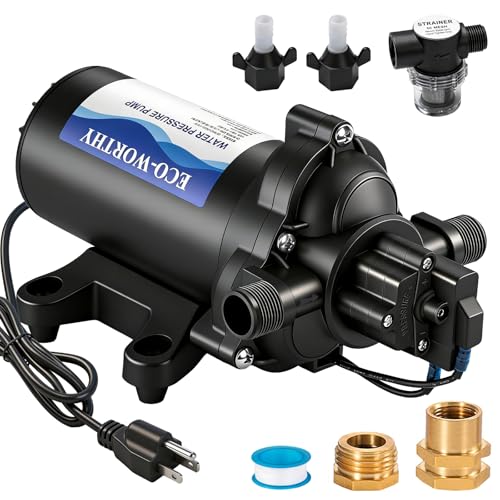
The ECO-WORTHY 33-Series is the pick for garden hoses, sprinklers, and irrigation runs that need a moderate lift. It is a compact diaphragm pump that plugs into a standard outlet, switches on demand, and ships with garden hose adapters so it can join a hose line without a hunt for fittings. Its flow and pressure sit in the middle of this guide, which suits one or two outlets running at once rather than a full household.
Specs
- 110V AC power supply
- 4.0 GPM flow rate
- 50 PSI rated pressure
- Self-priming diaphragm pump with pressure switch
- Includes garden hose adapters
- Model number DPHC-T33-110V
Best for: Gardeners and homeowners boosting hose-fed sprinklers and irrigation.
Watch out for: At 4.0 GPM it will not carry several household fixtures at once, so keep it to hose, garden, and single-outlet jobs.
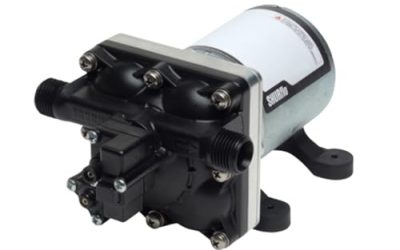
SEAFLO 33-Series Water Pressure Pump, 115V AC, 3.3 GPM, 45 PSI

The SEAFLO 33-Series is the pick for small freshwater systems in RVs, cabins, boats, and off-grid setups with mains power. Its three-chamber diaphragm design, smart pressure switch, and 45 PSI shut-off give steady on-demand flow for a tap or shower without a large pump footprint. The listing also notes NSF, CE, and RoHS certification with UL listing, which matters when the pump sits in a drinking-water line. Its compact size also makes it easier to fit into the tight utility spaces common in RVs and cabins.
Specs
- 115V AC power supply, 0.75 amps current draw (1.2 amps maximum)
- 3.3 GPM flow capacity
- 45 PSI shut-off pressure with adjustable pressure switch
- Self-priming up to 6 feet
- NSF, CE, and RoHS certified, UL listed
- 4-year warranty
Best for: RV, marine, cabin, and small freshwater systems on 115V power.
Watch out for: Its 3.3 GPM flow suits one or two fixtures at a time, and it needs a 115V AC supply, so it is not a drop-in choice for a 12-volt-only system.
Which One Fits Your Situation
A whole house on weak city water
Choose the Simer 4075SS-01. Its 3/4 HP motor and stainless steel build are made for a permanent inline spot, and its automatic activation lifts pressure across every fixture at once. Plan for a plumber to fit it into the main line and to check that your pipes can carry the added pressure.
One shower or tap that only trickles
Choose the TDRSUPER. Its compact diaphragm design and automatic start and stop target a single outlet, and its higher flow and pressure figures give a weak shower a clear lift. It installs near the outlet that needs help, so the rest of the house stays untouched. Keep the listing’s conflicting flow and pressure figures in mind and confirm them before you buy.
An RV, boat, or cabin freshwater system
Choose the SEAFLO 33-Series. Its 115V AC supply, 3.3 GPM flow, and 45 PSI shut-off match small freshwater setups, and its NSF and UL listings suit drinking-water lines. Its compact footprint fits tight utility spaces, and the on-demand switching means it only runs when a tap opens. Make sure your installation has mains power, since this is not a 12-volt pump.
Garden hoses, sprinklers, and irrigation
Choose the ECO-WORTHY 33-Series. Its garden hose adapters, on-demand switching, and mid-range flow and pressure fit hose-fed watering without replumbing the house. The included adapters save a separate trip for fittings, and the on-demand switching stops the pump running between watering sessions. The TDRSUPER is the backup here if you need more flow for a longer hose run.
Common Mistakes
- Buying on the biggest pressure number without checking whether the pump’s flow covers all the fixtures you run at once.
- Ignoring incoming pressure, so the pump’s boost pushes total pressure past what pipes and appliance valves can handle.
- Fitting a pump made for one tap into a whole-house job, then wondering why the upstairs shower still goes weak.
- Skipping the fitting sizes, so the pump arrives with ports that do not match your pipes and needs adapters you did not plan for.
- Choosing a 12-volt pump for a mains-powered setup, or a mains pump for a battery-only RV, without checking the voltage on the listing.
Safety Before You Install
Match the pump’s voltage to your supply before you plug anything in: every pump in this guide runs on 110 or 115 volts, and the wrong supply can damage the motor. Keep electrical connections dry and away from standing water, and site the pump where it can stay ventilated. Never assume a pump can run dry; only the SEAFLO listing here describes run-dry capability, while the TDRSUPER listing describes overload and overheat protection instead. For an inline whole-house pump such as the Simer, hire a licensed plumber, since the work involves cutting into the main supply line and checking that total pressure stays within what your pipes and fixtures are rated to carry.
Frequently Asked Questions
Will a booster pump fix low pressure from a well?
Not on its own. A booster pump adds pressure to water that already arrives with some flow, so it suits weak city supplies and storage-fed systems. If a well runs dry, the pump short-cycles, or flow has fallen suddenly, the well, the supply line, or the existing pump needs diagnosis first, since boosting a failing supply only hides the fault.
How much pressure is safe for my home plumbing?
It depends on your pipes, joints, and appliance inlet valves, so there is no single safe number for every house. Add the pump’s stated boost to your incoming pressure and compare the total against the ratings on your fixtures and flexible hoses. If the total looks close to a limit, choose a smaller boost or a pump with an adjustable setting.
Do I need a plumber to install a booster pump?
For an inline whole-house pump, yes in most cases, because the work means cutting into the main supply line and checking pressure across the system. A compact plug-in diaphragm pump near a single tap or hose is a simpler job, but you still need the right fittings, a dry power outlet, and a leak check after the first run.
Can a water pressure pump run dry?
It depends on the model. The SEAFLO listing describes run-dry capability, while the TDRSUPER listing describes overload and overheat protection rather than dry running. Check the listing for dry-run or overload protection before leaving any pump to run unattended, and shut it off if the water supply stops.