Key takeaways
- Five affordable portable water filter pumps compared for camping and emergencies, with micron ratings, flow rates, cartridge life and virus limits explained.
As an Amazon Associate, we earn from qualifying purchases made through links on this page.
A hand pump filter solves a specific problem that straw filters and gravity bags do not. With a pump, you drop an intake hose into a stream, a shallow puddle or a storage container, work the handle, and fill any bottle, pot or hydration reservoir directly, including containers that cannot be squeezed or hung. That makes pump filters the practical choice for group camping, base camps, emergency preparedness kits and any trip where several people draw water from the same source. The five models below sit in the entry-level to mid-range tier of the pump category, well under the cost of expedition-grade purifiers, and each one is a genuine hand-operated pump rather than a straw or a gravity system wearing pump clothing.
Before choosing, it helps to be clear about what a pump filter can and cannot do. Four of the five models here are microfilters: their makers rate them to remove bacteria and protozoan cysts such as Giardia and Cryptosporidium, plus sediment. Microfilters do not remove viruses, and their manufacturers say so. One model, the Survivor Filter PRO, uses a much finer final membrane and is marketed by its maker as a purifier, with company-cited laboratory reports covering viruses. That distinction matters more than any other specification on this page, and it is flagged for every product below.
What to look for in a portable water filter pump
Pore size and what it stops. Filter ratings are given in microns. A 0.2-micron element is the long-standing standard for backcountry microfilters: bacteria are larger than that, and protozoan cysts are larger still, so a sound 0.2-micron barrier handles both. Viruses are far smaller, roughly a tenth the size or less, so they pass through a 0.2-micron filter. Only a membrane rated around 0.01 to 0.02 micron, or a true purifier, addresses viruses. If your travel involves water sources with likely human contamination upstream, that difference should drive your choice.
Filter media and field maintenance. Pleated glass-fiber cartridges (Katadyn) give high flow and are protected by a cleanable screen. Ceramic elements (MSR MiniWorks EX, and the Katadyn Vario prefilter disc) can be scrubbed in the field to restore flow, which suits silty water. Hollow-fiber membranes (MSR TrailShot) are light and fast but must never freeze once wet, because ice expansion can crack the fibers invisibly. Every pump slows down as it loads with sediment; a model you can clean or backflush at camp will hold its flow rate far longer than one you cannot.
Flow rate and pumping effort. Manufacturers rate these pumps between about half a liter and two liters per minute under clean-water conditions. Real output depends on your arm and the state of the cartridge. A dual-action piston, as on the Katadyn Vario, moves water on both strokes and feels noticeably less tiring when filling several bottles for a group.
Cartridge life and running cost. Rated capacities here run from about 1,150 liters to figures the makers state in the tens of thousands for one membrane model. Treat headline capacities as best-case numbers achieved with clear water; muddy sources shorten them. Check that a replacement cartridge exists for the model you choose and that it can be swapped without tools.
Carbon stages and taste. Several pumps add an activated carbon element after the main barrier. Carbon does not change the microbiological rating, but it improves taste and reduces some chemicals and odors, which matters when your source is a slow lowland river rather than a mountain stream.
Connections and weight. Quick-connect fittings and adapters for wide-mouth bottles and hydration reservoirs save real frustration at the water’s edge. Weight runs from about 150 grams for the smallest squeeze-operated pump to roughly 450 grams for a full-size ceramic model, so decide whether the pump lives in a solo pack or a shared group kit.
The 5 best affordable portable water filter pumps
1. Survivor Filter PRO — the only virus-rated pump in this price tier

ASIN: B00QFXGSIY
The Survivor Filter PRO is a three-stage hand pump built around an ultrafiltration membrane rated at 0.01 micron, ten to twenty times finer than the microfilters below. Water passes a 0.1-micron pre-filter, then an activated carbon stage, then the membrane. Survivor Filter cites independent laboratory reports for the design showing reduction of viruses, bacteria and protozoa, and also cites testing for heavy-metal reduction. That makes this the one pump in this roundup its maker positions for sources where viruses are a realistic concern, such as lowland rivers and international travel, rather than only high mountain water. The company rates flow at up to about half a liter per minute, slower than the big Katadyn and MSR pumps, and rates the membrane for a very long service life with backflushing, though that figure assumes clean source water and regular backwashing with the included syringe system.
Who it is for: preparedness kits, aid and mission travel, and campers drawing from slow, warm, low-elevation water where a plain microfilter leaves a gap.
Limitations, per the specifications: the fine membrane is the reason for the modest flow rate, so filling bottles for a large group takes patience. The virus and heavy-metal claims rest on the manufacturer’s cited lab reports for this model rather than on a certification printed for every production unit, and the carbon and pre-filter stages are consumables that need periodic replacement even though the membrane itself is long-lived.
2. Katadyn Hiker Pro — the lightweight group workhorse

ASIN: B075TTTX2R
The Hiker Pro is Katadyn’s best-known pump and the lightest full-size lever pump here at about 310 grams. Its pleated glass-fiber cartridge is rated at 0.2 micron and is wrapped in a cleanable filter protector that keeps silt off the element, so flow holds up better in murky water than an unprotected cartridge. Katadyn rates output at about one liter per minute and cartridge life at up to 1,150 liters depending on water quality. An activated carbon core improves taste. Quick-connect fittings let you pump straight into hydration reservoirs and most standard bottles without holding them under a spout, and the transparent housing on this version lets you see the cartridge condition at a glance.
Who it is for: backpacking pairs and small groups who want a proven, light pump with fast bottle filling and simple field care.
Limitations, per the specifications: as a 0.2-micron microfilter it removes bacteria and protozoa but not viruses, which Katadyn states plainly. The 1,150-liter cartridge life is the shortest in this roundup, so heavy users will buy replacement cartridges more often, and the pleated element itself is not scrub-cleanable the way a ceramic element is; once it clogs beyond what the protector prevents, it is replaced rather than restored.
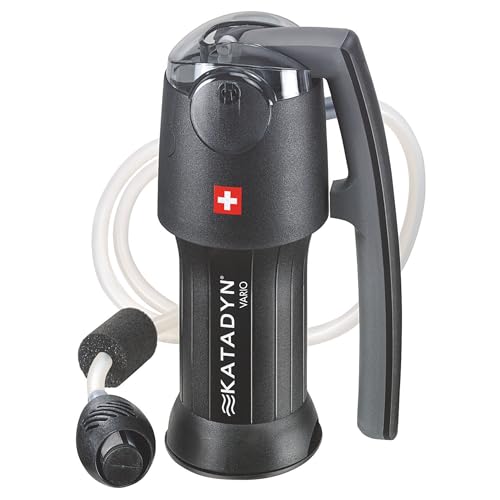
3. Katadyn Vario — fastest flow, dual-mode pumping
ASIN: B000KUVVY4
The Vario adds a second technology in front of its main cartridge. Incoming water first crosses a ceramic prefilter disc rated at 0.2 micron, then a pleated glass-fiber cartridge, then activated carbon granules. Its dual-action piston pumps on both the push and the pull, and Katadyn rates it at up to two liters per minute in its faster-flow setting, the quickest figure in this roundup. A rotating base lets you switch between a longer-life mode that uses the ceramic disc and a faster mode that bypasses it for clear water. Katadyn rates cartridge capacity at up to 2,000 liters, and the unit weighs about 425 grams. Output adapters cover wide-mouth bottles and hydration systems.
Who it is for: group leaders, canoe and base-camp users, and anyone filling several large containers at one stop who values speed over minimum weight.
Limitations, per the specifications: it remains a microfilter, so viruses are outside its rating even with the ceramic stage. At about 425 grams it is one of the heavier pumps here, the two-mode mechanism has more seals and moving parts to keep clean than a basic single-action pump, and running it in faster-flow mode on silty water loads the main cartridge sooner because the ceramic prefilter is bypassed.
4. MSR TrailShot — the pocket-size pump for solo movers
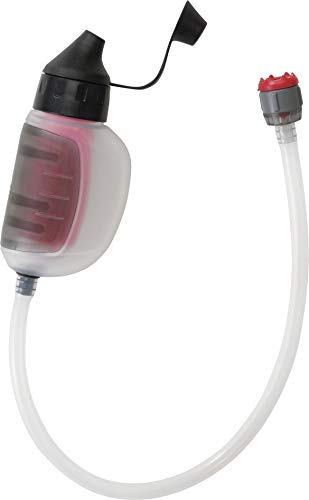
ASIN: B01N7GC9Z6
The TrailShot replaces the lever with a squeeze bulb: you drop its intake hose into the source and repeatedly squeeze the soft body by hand, which drives water through a 0.2-micron hollow-fiber element at up to one liter per minute by MSR’s rating. The payoff is size. At roughly 150 grams it disappears into a hip-belt pocket, and the long intake hose reaches shallow seeps and thin puddles that a bottle-top filter cannot use. MSR rates the cartridge for up to 2,000 liters, and flow is restored in the field by shaking and swirling the unit to backflush the fibers, with no tools and no spare parts to carry. It drinks directly like a straw or fills bottles from its discharge spout.
Who it is for: trail runners, fastpackers and solo hikers who refill small amounts often and count every gram.
Limitations, per the specifications: squeezing a bulb for a full liter is slower work in the hand than a lever pump, so it suits one person rather than a group. The hollow-fiber element must be protected from freezing once it has been used, a real constraint on winter trips, and like the other microfilters here it does not remove viruses. The small cartridge also clogs faster in silty water, so the backflush routine becomes a habit rather than an occasional fix.
5. MSR MiniWorks EX — the field-serviceable ceramic classic
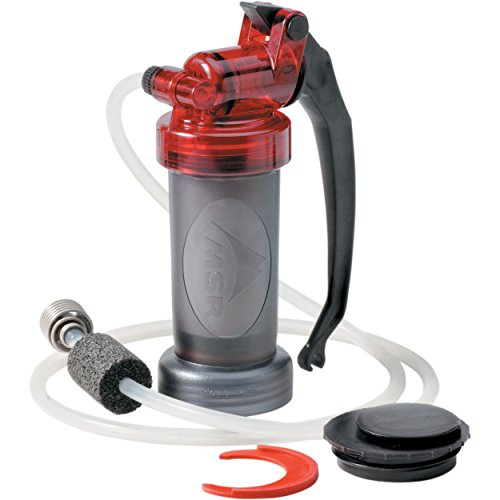
ASIN: B000BBF2RY
The MiniWorks EX is built around a ceramic and carbon-core cartridge rated at 0.2 micron. Its defining trait is maintenance: when flow drops, you open the pump, scrub the ceramic element with the included pad, measure it against the included gauge, and keep going. MSR rates the cartridge at up to 2,000 liters before replacement and flow at about one liter per minute. An air chamber in the design smooths the pumping stroke, and the outlet threads directly onto wide-mouth bottles and MSR storage bags, so filtered water goes exactly where you want it with no juggling. At about 456 grams it is the heaviest pump in this list, which is the honest trade for the most repairable design in the group.
Who it is for: long-distance hikers, paddlers and preparedness users who expect silty water and want a pump they can restore at camp for years rather than replace.
Limitations, per the specifications: the weight and bulk are real next to the TrailShot or Hiker Pro. Scrubbing the ceramic gradually wears the element, so the gauge check matters, and a dropped ceramic cartridge can crack. It is a microfilter, so viruses are not removed, and the one-liter-per-minute rating assumes a clean, freshly scrubbed element; a neglected one pumps far slower.
Comparison table
| Pump | Filter type | Pore size (maker rating) | Flow rate (maker rating) | Cartridge life (maker rating) | Weight | Removes viruses |
|---|---|---|---|---|---|---|
| Survivor Filter PRO | 3-stage pump with ultrafiltration membrane | 0.01 micron | Up to about 0.5 L/min | Membrane rated for extended use with backflushing | Full kit, mid-weight | Yes, per manufacturer’s cited lab reports |
| Katadyn Hiker Pro | Pleated glass fiber with carbon core | 0.2 micron | About 1 L/min | Up to 1,150 L | About 310 g | No |
| Katadyn Vario | Ceramic prefilter, glass fiber, carbon | 0.2 micron | Up to 2 L/min | Up to 2,000 L | About 425 g | No |
| MSR TrailShot | Hollow fiber, squeeze-bulb pump | 0.2 micron | Up to 1 L/min | Up to 2,000 L | About 150 g | No |
| MSR MiniWorks EX | Ceramic with carbon core | 0.2 micron | About 1 L/min | Up to 2,000 L | About 456 g | No |
FAQ
Do portable pump filters remove viruses?
Most do not. A standard 0.2-micron microfilter, which covers four of the five pumps above, is rated for bacteria and protozoan cysts only, because viruses are much smaller than the pores. The Survivor Filter PRO is the exception in this list: its final membrane is rated at 0.01 micron and its manufacturer cites laboratory reports for virus reduction. Where virus risk is high and you carry a microfilter, pair it with chemical treatment or boiling as a second step.
How is a pump filter different from a straw filter or a gravity filter?
A straw filter treats water only as you drink it, one sip at a time. A gravity filter needs a filled bag hung above your container and time to drip. A pump filter actively moves water from any source, even a shallow puddle, into any container you own, at a pace you control. For cooking water, group use and emergency storage, that active filling is the whole point.
How long does a pump filter cartridge really last?
Manufacturers rate life with relatively clear test water. Silt, algae and tannins shorten it, sometimes dramatically. Models you can maintain in the field, by scrubbing a ceramic element, rinsing a filter protector or backflushing hollow fibers, get much closer to their rated life than sealed cartridges used in dirty water. Prefiltering through a bandana or letting a bucket settle overnight extends any cartridge’s life.
Can these pumps handle salt water or chemically contaminated water?
No. None of the pumps in this roundup desalinates, and their carbon stages only reduce some tastes and chemicals; they are not rated to make industrially or agriculturally contaminated water safe. They are designed for natural freshwater sources such as streams, lakes and stored rainwater.
What maintenance does a pump filter need after a trip?
Rinse or backflush the element as the maker directs, let every part dry fully before storage so mildew cannot grow, and inspect seals and hoses for cracks. Ceramic elements should be stored protected from knocks. If a hollow-fiber pump may have frozen since its last use, treat its rating as unreliable and replace the cartridge.
Conclusion
For most campers and backpackers, the Katadyn Hiker Pro hits the balance of weight, speed and simplicity, while the Katadyn Vario earns its place when a group needs volume fast. Choose the MSR TrailShot when the pump must vanish into a pocket, and the MSR MiniWorks EX when field repairability over years matters more than grams. If your water sources carry a realistic virus risk and the budget has to stay in this tier, the Survivor Filter PRO is the only pump here whose manufacturer rates and lab-documents it for that job, at the cost of slower pumping. Match the micron rating to your water first, then pick the pump action and weight you will actually carry.